New study sheds light on the threat of ‘marine darkwaves’ to ocean life
More than a fifth of the global ocean has gradually lost underwater light. But short, intense “marine darkwaves” can be just as damaging for life below the surface.
François Thoral, Postdoctoral Research Fellow in Marine Ecology, University of Waikato, Christopher Battershill, Professor in Coastal Science, University of Waikato, David R Schiel, Distinguished Professor in Marine Science, University of Canterbury, Shi
21 January 2026
Life in the ocean runs on light. It fuels photosynthesis, shapes food webs and determines where many marine species can live.
Alarming as this picture is, focusing only on gradual darkening may miss the most ecologically damaging part of the story.
Our newly published study introduces the phenomenon of “marine darkwaves”: sudden, intense episodes of underwater darkness that can last from days to months and push marine ecosystems into acute stress.
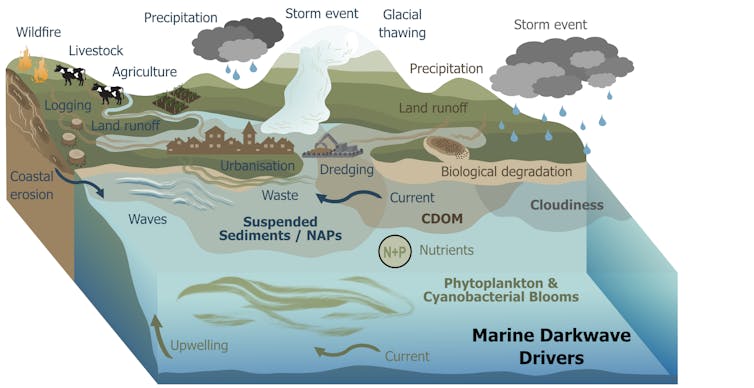
Darkness events are often triggered by storms, floods, sediment plumes or algal blooms. As with marine heatwaves, these short, intense episodes can be just as ecologically disruptive as slow, long-term trends.
Unusual underwater darkness is harmful for a range of marine ecosystems, yet the phenomenon did not have a name and definition until the marine darkwave framework was developed. Artwork of a darkened algal forest by Cassandre Villautreix, underwater picture by Leigh Tait.
Why light matters underwater
When light within the ocean drops suddenly, even for a few days, marine ecosystems can suffer. Prolonged darkness can slow growth, reduce energy reserves and in severe cases lead to dieback or mortality.
Fish, sharks and marine mammals can also change their behaviour when visibility drops, altering feeding and movement patterns.
Until now, scientists have examined ways to track long-term coastal darkening but have lacked a consistent way to identify, measure and compare extreme short-term light-loss events across regions and depths.
In other words, we have known this phenomenon exists – but we haven’t had a shared language to define and describe it. With marine darkwaves, we now have an event-based framework for extreme underwater darkness.
Darkwaves occur when underwater light falls below a depth-specific threshold for a minimum duration, relative to what is normally expected at that location. This allows scientists to identify when conditions shift from merely dim to unusually dark.
Importantly, this framework works across different depths, where light conditions naturally vary; across local to regional scales, from coastal reefs to entire coastlines; and across multiple data sources, including light sensors and satellite observations.
Its consistency enables meaningful comparison of events that were previously difficult to place into broader contexts.
What our research revealed
Our study used long-term datasets from both hemispheres in markedly different coastal regions.
In California, 16 years of underwater light measurements revealed repeated darkwave events, some lasting several weeks. In Aotearoa New Zealand, ten years of monitoring data from Auckland’s Hauraki Gulf showed rapid drops in underwater light during storms, at depths of seven and 20 metres.
Satellite data extending back 21 years revealed a broader pattern. Along New Zealand’s East Cape coast, up to 80 marine darkwaves have occurred since 2002, most linked to storms and river-driven sediment plumes.
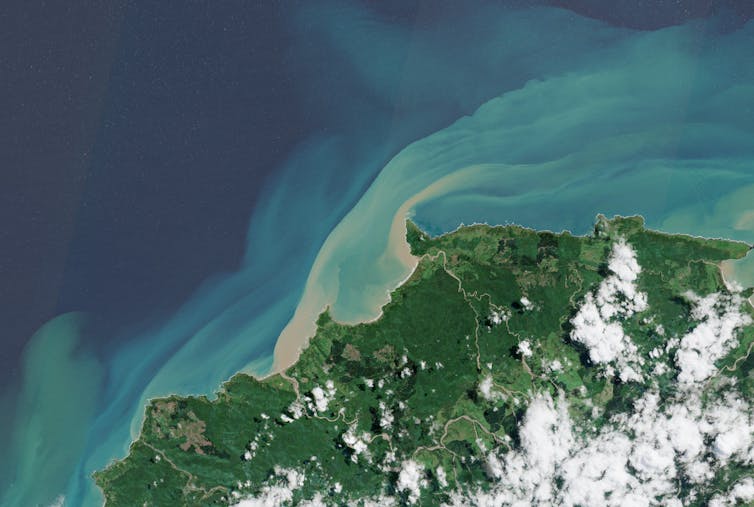
Cyclone Gabrielle in 2023 provided a stark example. The storm delivered vast amounts of sediment to coastal waters, smothering many reefs and creating prolonged underwater darkness over large areas.
In some places, the seabed received almost no light for several weeks.
Heavy sediment runoff around Waihau Bay, in New Zealand’s Eastern Bay of Plenty. This was observed following Cyclone Gabrielle on February 14, 2023 - an event that created marine darkwaves for several weeks, with continuing ecological impacts.Copernicus Sentinel data (2023), CC BY-NC-SA
Long-term averages are important, but they can smooth over the very events that cause the greatest ecological damage.
Just as a single marine heatwave can devastate kelp forests and coral reefs, a single marine darkwave can sharply reduce photosynthesis and disrupt ecosystems already stressed by warming, acidification and nutrient pollution.
Climate change is likely to increase the frequency and intensity of these events. Heavier rainfall, stronger storms and intensified land use all increase sediment and organic matter flowing into coastal waters, reducing water clarity and light availability.
Our framework allows identification of discrete periods when light thresholds critical for ecosystem function are crossed.
By focusing on extremes, it provides clearer insights into acute stress on coastal ecosystems. In New Zealand particularly, this information is increasingly important for iwi (tribes) and hapu (sub-tribes), coastal communities, conservation groups and environmental managers making decisions about land use, restoration and marine protection.
Related monitoring work is already underway in parts of New Zealand, where expanded sensor networks aid in linking land-based processes to changes in underwater light, and linking these to ecological changes on coastal reefs.
Ultimately, marine darkwaves remind us that the ocean doesn’t always change slowly. Sometimes, it changes abruptly and quietly if we don’t pay attention.
There is also reason for cautious optimism. Many marine darkwaves are driven by land–sea connections, so their frequency and intensity are not inevitable.
Reducing sediment runoff through nature-based solutions, such as restoring wetlands, stabilising riverbanks, improving harvest techniques of exotic forests, and replanting native forests in vulnerable catchments can directly increase water clarity and underwater light.
Understanding marine darkwaves is not only about detecting change, but also about identifying practical pathways to protect coastal ecosystems before further darkness descends.
The authors acknowledge the contribution of Rahera Ohia, Ngati Pukenga, Jean Thoral, Leigh Tait and Cassandre Villautreix.
François Thoral receives funding from the NZ Ministry of Business, Innovation and Employment MBIE (Endeavour Fund Tau Ki Akau UOWX2206). He is affiliated with the University of Waikato, University of Canterbury and Earth Sciences New Zealand.
Christopher Battershill receives funding from the NZ Ministry of Business, Innovation and Employment MBIE (Endeavour Fund Tau Ki Akau UOWX2206 is relevant to this project). He is employed with the University of Waikato and also receives contestable grant funding from other agencies (eg Regional Councils and Department of Conservation).
David R Schiel receives funding from the New Zealand government public good research fund (via the Ministry of Business, Innovation and Employment; Endeavour Fund Tau Ki Akau UOWX2206).
Shinae Montie receives funding from The Australian Research Council and the Winifred Violet Scott Charitable Trust. She is associated with the University of Western Australia.
This article is republished from The Conversation under a Creative Commons license.
RUGBY Black Sticks women's coach Phil Burrows is eager to see internal competition at this week's four-team international tournament in Dunedin More...
BUSINESS Pic's Peanut Butter is boasting huge financial success, with sales reaching 40-million dollars More...