Global air travel is a well-oiled machine, which can be thrown into disarray by unplanned closures.
Major international airports in Dubai, Abu Dhabi, and Doha have been closed this week due to the war in Iran and wider conflict in the Middle East, leaving many Australian passengers stranded.
This week alone, more than 10 million seats were expected to fly in and out of the three airports, with 123,000 of those held by Australians.
Freight flights have also been grounded at these airports, many of which contain perishable items such as medical supplies, flowers, and food that won't reach their final destinations in time.
But even as the area starts to reopen passenger and freight flights via emergency corridors, the process of re-routing around the region is tricky, and aviation experts say it will likely take months to recover from the disruptions once restrictions are lifted fully.
According to Guido Carim Junior, an aviation expert from Griffith University, the flight industry can be inflexible in its scheduling.
"If something breaks, it's really terrible to make up the time loss," Dr Carim Junior said.
So what happens after a major airspace closure? How do pilots know where they should fly — and how long can it take to get things back to normal?
How has airspace restriction impacted global air traffic?
According to Bloomberg, more than 23,000 flights have been cancelled since the crisis began.
Under normal circumstances, a plane's flight route is chosen before it takes off, says aviation lecturer Salim Hijazeen from Swinburne University of Technology.
This is based upon its efficiency and the agreements airlines have with different countries to use their airspace.
"Generally speaking, the airlines will always select the most efficient path and the quickest path," Mr Hijazeen said.
The longer the route, the more fuel is spent.
For Australians going to Europe, this often means stopping in the Middle East, as it is the most direct route.
But when Qatar, Israel, Iran, Iraq and other countries in the region closed their airspace, this took out a major central corridor.
When a country closes its airspace, this isn't a legally binding notice — but it does mean that pilots risk being attacked if they fly through that area at any altitude.
Although some flights are resuming on designated flight paths through the conflict zone, most air traffic is using narrow corridors to the north and south, avoiding a range of simultaneous international conflicts.
"[The flights are] going north of the Iranian airspace, or south to avoid the conflicts," said Rico Merkert, the chair of transport and supply chain management at the University of Sydney.
Professor Merkert said he'd seen passenger flows on airlines other than Qatar, Emirates or Etihad going to and from Singapore, Hong Kong, and Istanbul instead.
He's also seen some interesting routes this week, from Helsinki to Johannesburg, and into Sydney.
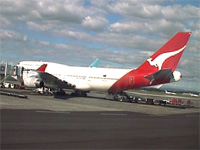
It's also been reported that the Qantas long-haul flight direct from Perth to London has been rerouted through Singapore to avoid the airspace over the Gulf.
Meanwhile, there are concerns about the war's impact on aviation fuel costs.
Jet fuel expenses, which usually account for 20 to 30 per cent of an airline's operating costs, could increase if the war continues, according to S&P Global.
Do other airports have capacity for extra planes?
Regional airports such as Muscat in Oman have seen increases in flights since airspace in neighbouring countries was restricted.
Normally, about 200 flights pass through Muscat each day, compared with more than 1,000 through Dubai when it is fully operational.
Surrounding regional airports may not have the facilities to accommodate many passengers or enough fuel to supply additional planes, Mr Hijazeen said.
"They need to think, 'OK, if we divert to a more regional airport, they may not have the facilities [we need to operate],'" he said.
Airports are often running close to their time slot capacity, so fitting in extra flights is quite hard logistically.
"Airlines can't just pop up and say now we have 15 aircraft that need to go to Hong Kong at 6am in the morning," Professor Merkert said.
There's also the constraint of airspace, and how many planes are allowed to be waiting to land in a given location.
"You're going to be able to add a couple of extra flights in a particular route, but I wouldn't say we'll be able to accommodate all the flights that haven't happened," Dr Carim Junior said.
Even major international airports well away from the conflict, such as Heathrow, have been affected with many flight cancellations.
How do pilots know where they can fly?
To stay on designated routes and mark out countries' airspaces, pilots use a digital database of virtual points in the air known as waypoints.
"You can't really see the physical borders of countries when you're in the air," Dr Carim Junior said.
Each route has its own sequence of waypoints, along which planes use multiple navigational systems to keep on track.
GPS and on-board sensors measure the plane's velocity and direction, and these are checked against the waypoints' locations.
At the same time, aircraft are always broadcasting information to air traffic control, which is what we see on sites like FlightRadar.
"On the radar display, you can see so much information about these aircraft," Mr Hijazeen said.
This can include a plane's altitude, size, direction of travel, type, and where it has come from.
When an air traffic controller sees a plane pass a waypoint, they will check in with the pilots, providing important information such as weather and whether closure notices have been issued for their planned route.
Once a plane flies outside of the air traffic control's region of waypoints, they tell the plane to check in with the next air traffic control point.
How many planes can fly on a given route?
While major flight routes on FlightRadar appear as a stream of planes travelling in a row, in reality, the positions of planes are carefully monitored.
Commercial planes cruise at altitudes between 30,000 and 40,000 feet, and must be separated either vertically or horizontally.
The number of aircraft allowed at a given altitude can vary by airspace and the countries that control them, but generally, air traffic controllers avoid having two planes flying at the same altitude nearby.
"Mainly due to the air traffic controllers' ability to control multiple planes at the same time," Dr Carim Junior said.
It can also depend on the types of planes flying and how much they disturb the air for others.
For instance, big planes such as the Airbus A380 can cause air turbulence behind them, strong enough to affect smaller ones.
"A380s, for example, are extremely heavy … we have to give a little more space," Dr Carim Junior said.
This makes re-routing planes for longer periods of time even more challenging.
How long might it take to get back to normal?
In the past, we have seen events such as volcanic eruptions close or shut down airports and routes for maybe a few days.
"I would say … one full day of closure of an airport is going to take weeks to re-accommodate all the passengers," Dr Carim Junior said.
However, it's hard to say how long it will take for things to return to a relatively normal situation, with restrictions expected to remain in place as long as the conflict continues.
If airlines deem the re-routed flight paths too congested or the risk from nearby airspace closures too great, they won't offer the same number of flights.
"[There's] certainly going to be months of disruption, in my view. It's something that you can't just fix overnight," Dr Carim Junior said.
"Recovering from a disruption is always going to be more challenging than the disruption itself."
Are you impacted by the war in the Middle East?