Not an artefact, but an ancestor: why a German university is returning a Maori taonga
For the Te Aitanga-a-Hauiti, the Hinematioro Pou is the material presence of an ancestor.
Michael La Corte, Research Associate, Curation and Communication, University of Tübingen, Annika Vosseler, Provenance and collection researcher, University of Tübingen
4 February 2026
Restitution debates – the question of whether a cultural object should be returned from a museum or other collection to a person or community – often begin with a deceptively simple question: who owns an object?
In colonial contexts, this question rarely has a clear answer. Histories of acquisition are often incomplete, disputed and overwhelmingly recorded from European perspectives. Legal documentation, where it exists at all, usually reflects unequal power relations rather than mutual consent. As a result, many restitution claims cannot be resolved through law alone.
This raises a fundamental question: should the spiritual, social and ancestral significance of an object for its community of origin outweigh unresolved legal arguments about possession?
The case of the Hinematioro pou, which is now being returned from the University of Tübingen to the Maori community Te Aitanga-a-Hauiti on the east coast of New Zealand’s north island, illustrates a restitution process grounded in cultural values. It shows what happens when decisions are guided primarily by spiritual meaning and relational responsibility, rather than by legal uncertainty surrounding colonial acquisition.
A pou is a carved wooden pillar that acts as a marker for tribal boundaries, stories or ancestors. The Hinematioro pou is an early carved panel depicting a standing ancestral figure.
For the Te Aitanga-a-Hauiti, the pou is neither a historical artefact nor a work of art in the western sense. It is the material presence of an ancestor, Hinematioro, who was an ariki (high-ranking leader). The pou is part of a living social order, not a testimony to a distant past.
Within Maori cultural logic, such an object is a taonga: a treasure that carries not only material, but also spiritual, social and genealogical value. Taonga possess mana and mauri – agency and life force – and require ritual relationships as well as responsibility.
This meaning became clear when the pou returned in 2019, for the first time in over 250 years, to Uawa (Tolaga Bay). It was met with a formal powhiri (welcome ceremony) with singing, speeches, tears and embraces – as if a long-absent relative had come home.
Witnessing this special moment made us and many others who were part of the event understand that the question of the pou’s future location is not a museological one for the community, but an existential one. It is not about possession, but about relationship.
How the taonga came to Germany
It is not possible to conclusively reconstruct how the taonga came to Europe. What is certain is that, in October 1769, it was taken from Uawa to Europe aboard the HMS Endeavour during James Cook’s first Pacific voyage.
The panel is widely regarded as one of the earliest surviving carved pou associated with Maori chiefly genealogies to have entered European collections. This occurred within a colonial context of profound power asymmetries.
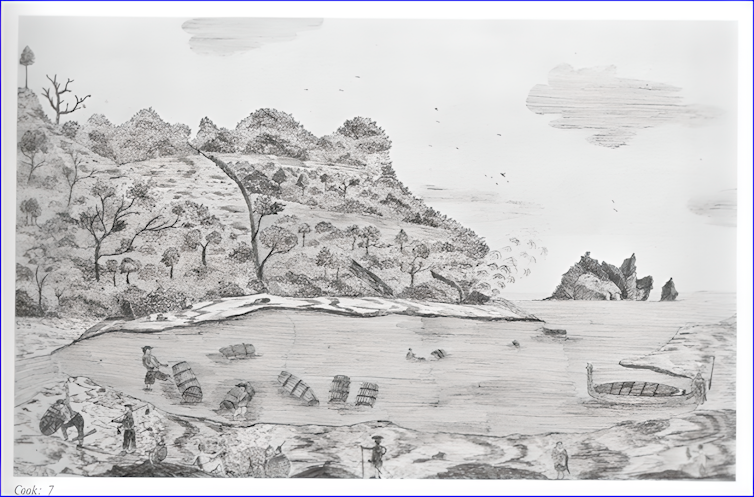
The Watering Place in Tolaga Bay, Opoutama, Cooks Cove sketch by James Cook 1769.British Museum, London
It is also not possible to establish how the pou was transferred. A range of possibilities exists, including gifting, coerced handover, exchange or theft. European sources provide no clear evidence, and perspectives from the source community are not sufficiently recognised in Europe. Therefore, a lack of documented violence cannot be taken as evidence of a voluntary transfer.
The object’s later path to Tübingen can only be partially traced. It may have circulated through several 19th-century scientific and collecting networks connected to the Cook expedition.
What is certain is that, in 1937, the pou entered the Ethnological Collection of the University of Tübingen through Emma von Luschan (1864–1941, wife to the anthropologist, explorer, archaeologist and ethnographer, Felix von Luschan) when their collection was curated by the anthropologist and ethnologist Augustin Krämer.
A turning point came in the 1990s, when the panel was identified using a drawing from the Cook expedition held at the British Library. What proved decisive, however, was the establishment of direct relationships with the Hauiti Iwi (tribe or people).
In the following years, close cooperation developed between the University of Tübingen and the Hauiti Iwi. In 2019 the pou was loaned back to the Maori. A jointly curated exhibition Te Pou o Hinematioro (2025–26) at Hohentübingen Castle back in Germany followed – an expressions of a partnership in which trust could grow. The restitution of the pou is therefore not the outcome of conflict, but the result of a long-term relationship that deepened during the exhibition process.
From a legal perspective, the university was not obliged to return the object. Under German civil law, the pou is considered university property, and no binding restitution framework exists for colonial contexts.
Nevertheless, political approaches to colonial collection material in Germany have shifted in recent years. Recent national guidelines encourage transparency, provenance research, dialogue with source communities and restitution as a possible outcome. This reflects a shift away from narrow legal ownership toward acknowledging colonial power imbalances in collection histories.
Decisions about restitution are primarily political and institutional in nature. These decisions raise questions of responsibility: what obligations do present-day collections have towards the circumstances in which their holdings were acquired, and what role do institutions wish to play in global debates on heritage, memory and justice? Universities, with their extensive collections and deep involvement in colonial knowledge production, are particularly affected by these issues.
Where legal histories are inconclusive – as they often are in colonial contexts – restitution cannot be decided by ownership alone. For source communities to be genuine partners, their social, spiritual and ancestral relationships with heritage must be recognised. Otherwise, restitution debates risk perpetuating the very hierarchies it aims to dismantle.
The authors do not work for, consult, own shares in or receive funding from any company or organisation that would benefit from this article, and have disclosed no relevant affiliations beyond their academic appointment.
This article is republished from The Conversation under a Creative Commons license.