Labeling dissent as terrorism: New US domestic terrorism priorities raise constitutional alarms
A new Trump administration policy threatens free speech and association by targeting individuals and groups as potential domestic terrorists based on their beliefs rather than their actions.
Melinda Haas, Assistant Professor of International Affairs, University of Pittsburgh
4 December 2025
A largely overlooked directive issued by the Trump administration marks a major shift in U.S. counterterrorism policy, one that threatens bedrock free speech rights enshrined in the Bill of Rights.
National Security Presidential Memorandum/NSPM-7, issued on Sept. 25, 2025, is a presidential directive that for the first time appears to authorize preemptive law enforcement measures against Americans based not on whether they are planning to commit violence but for their political or ideological beliefs.
This structure allows the president to direct law enforcement and national security agencies, with little opportunity for congressional oversight.
This seventh national security memorandum from the Trump White House pushes the limits of presidential authority by targeting individuals and groups as potential domestic terrorists based on their beliefs rather than their actions.
The memorandum represents a profound shift in U.S. counterterrorism policy, one that risks undermining foundational American commitments to free speech and association.
The presidential memorandum signed by Donald Trump identifies ‘anti-Christian,’ ‘anti-capitalism’ or ‘anti-American’ views as potential indicators that a group or person will commit domestic terrorism.Andrew Harnik/Getty Images
Presidential national security powers
Executive memoranda instruct government officials and agencies by delegating tasks and directing agency actions.
They can, for example, order a department to prepare reports, implement new policies, coordinate interagency efforts or review existing programs to align with the administration’s priorities.
Unlike executive orders, they are not required to be published. When these memoranda, like NSPM-7, relate to national security and military and foreign policy, they are called national security directives, although the specific name of these directives changes with each administration.
Many of these directives are classified. They may not be declassified, if at all, until years or decades after the end of the administration that issued them.
The stated purpose of NSPM-7 is to counter domestic terrorism and organized political violence, focusing mainly on perceived threats from the political left. The memorandum identifies “anti-Christian,” “anti-capitalism” or “anti-American” views as potential indicators that a group or person will commit domestic terrorism.
The memorandum claims that political violence originates with “anti-fascist” groups that hold the following views: “support for the overthrow of the United States Government; extremism on migration, race, and gender; and hostility towards those who hold traditional American views on family, religion, and morality.”
The strategy laid out in NSPM-7 includes preemptive measures to disrupt groups before they engage in violent political acts. For example, multiagency task forces are empowered to investigate potential federal crimes related to radicalization, as well as the funders of those potential crimes.
‘Domestic terrorist organizations’
The memorandum directs the Department of Justice to focus the resources of the FBI’s approximately 200 Joint Terrorism Task Forces on investigating “acts of recruiting or radicalizing persons” for the purpose of “political violence, terrorism, or conspiracy against rights; and the violent deprivation of any citizen’s rights.”
NSPM-7 also allows the attorney general to propose groups for designation as “domestic terrorist organizations.” That includes groups that engage in the following behaviors: “organized doxing campaigns, swatting, rioting, looting, trespass, assault, destruction of property, threats of violence, and civil disorder.”
Existing laws allow the secretary of state to designate groups as “foreign terrorist organizations” that are then subject to financial sanctions.
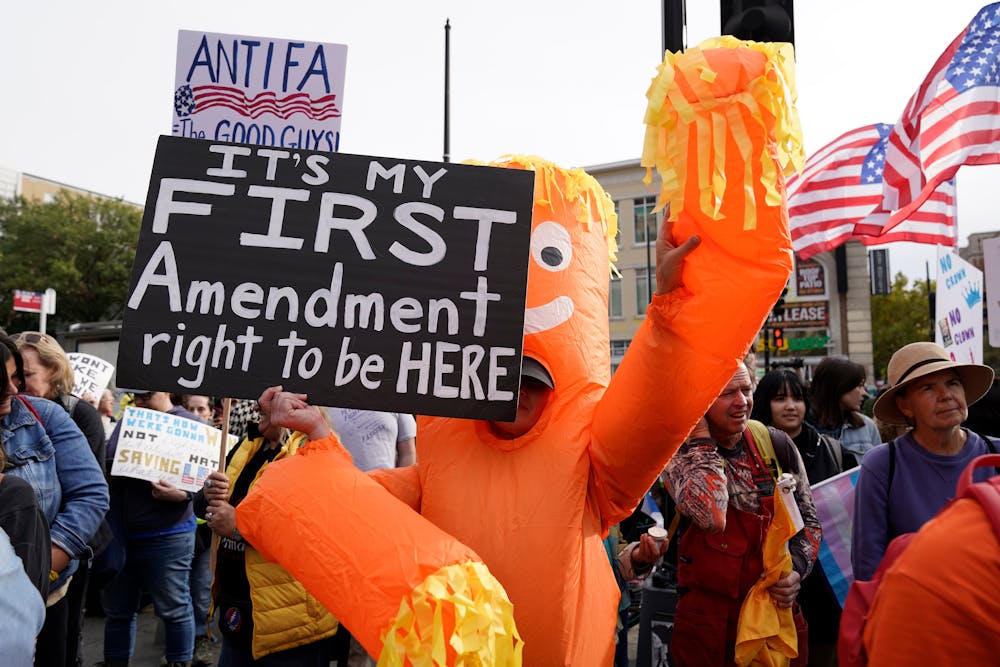
Would protesters like these at a Washington, D.C., ‘No Kings’ demonstration be seen as potential domestic terrorists by the Trump administration?Jose Luis Magana/AP
Defining terrorism
NSPM-7 marks a major conceptual shift in U.S. counterterrorism policy. Its focus on domestic terrorism significantly departs from historical approaches that primarily targeted foreign threats.
Since Ronald Reagan’s presidency, the U.S. government had treated terrorism as a global menace to democratic institutions, emphasizing protection of citizens and allies abroad. By moving away from a traditional law enforcement framework and recasting terrorism as an act of war, the Reagan administration situated the issue within the broader realm of Cold War geopolitics and military advantage.
After the 9/11 attacks, the Bush administration fused counterterrorism with national defense. The Bush-initiated global war on terrorism expanded the concept of who constituted a threat to include countries that harbored or aided terrorist organizations.
This standard was not focused on ideology but rather on tactical considerations, such as the feasibility of capture and continued threat to U.S. interests.
For example, the lethal drone strike on al-Qaida propagandist Anwar al-Awlaki in 2011 was justified on the basis that he was actively involved in plotting attacks and remained unreachable for capture.
During the first Trump presidency, executive orders were used to change counterterrorism policy, most notably through several iterations of a “travel ban” that attempted to restrict immigration from terror-prone countries such as Iraq, Iran, Somalia, Syria and Yemen.
The Biden administration redirected attention toward preventing catastrophic threats, especially from weapons of mass destruction in the hands of groups or individuals outside of governments, such as terrorist organizations.
First Amendment rights at risk
There is no single official definition of terrorism in U.S. law.
Instead, laws use different definitions based on their purpose, whether criminal law or laws relating to intelligence collection or civil liability.
Definitions in all those areas typically focus on identifying violent or dangerous acts done with the intent to intimidate or coerce civilians or influence government policy.
But more than redefining terrorism, NSPM-7 reorients the machinery of national security toward the policing of belief.
The First Amendment generally prevents the government from punishing people for unpopular opinions. It also protects the ability for people to associate to advance public and private ideas in pursuit of political, economic, religious or cultural goals.
The directive’s emphasis on ideological orientations – “anti-Christianity,” “anti-capitalism” and “anti-American” views – as indicators of domestic terrorism potentially jeopardizes First Amendment rights.
Thirty-one members of Congress sent a letter to Trump expressing “serious concerns” about NSPM-7, warning that it poses “serious constitutional, statutory and civil liberties risks, especially if used to target political dissent, protest or ideological speech.”
As the ACLU warns, any definition of terrorism that includes ideological components risks criminalizing people or groups based on belief rather than based on violence or other criminal conduct.
Congress has declined to create a domestic complement to the foreign terrorist designation in large part because of the potential for impinging on First Amendment–protected association and speech.
But I fear that chilling speech may be the point.
Silencing dissent
NSPM-7 does not authorize new actions in the legal and institutional framework for counterterrorism. It does not criminalize previously legal conduct.
Law professor Steve Vladeck frames this chill as “obeying in advance,” in which organizations self-censor rather than risk investigation, prosecution or defending against the “domestic terrorist” label.
Although left-wing violence has risen in the past decade, empirical evidence proves that this violence remains at very low absolute levels, well below historical levels of right-wing or jihadist violence.
In fact, most domestic terrorists in the U.S. are politically on the right, and right-wing attacks account for the vast majority of fatalities from domestic terrorism.
Yet NSPM-7 focuses disproportionately on left-wing ideologies. NSPM-7 departs from prior U.S. counterterrorism frameworks by prioritizing the suppression of ideologically motivated dissent, even in the absence of concrete evidence of violent intent.
Melinda Haas does not work for, consult, own shares in or receive funding from any company or organization that would benefit from this article, and has disclosed no relevant affiliations beyond their academic appointment.
This article is republished from The Conversation under a Creative Commons license.