To address this, app developers have responded with a vast ocean of productivity and focus apps, each promising to tame the chaos with timers, app blocking, habit reminders, and rewards designed to help you stay focused and be productive.
To understand whether these apps are worth our while, we first need to consider why staying focused is so difficult in the first place.
Why is it so hard to stay focused?
By and large, a lack of focus boils down to difficulties with self-regulation, the ability to monitor and manage thoughts, emotions and behaviours for goal pursuit.
In short, when a task feels boring, stressful, or tedious, it creates an unpleasant feeling. We then search for relief, and for most of us that comes by way of our smartphone, which has become our go-to coping device, even if it derails the work we need to do.
To cope with these demands, a new generation of focus apps has burst onto the productivity scene. These apps use gamification (the application of game design elements in non-game settings) and cute characters to encourage focused work.
Chief among these is Focus Friend, which briefly took over ChatGPT as the most downloaded app during its first month on the App Store in August this year.
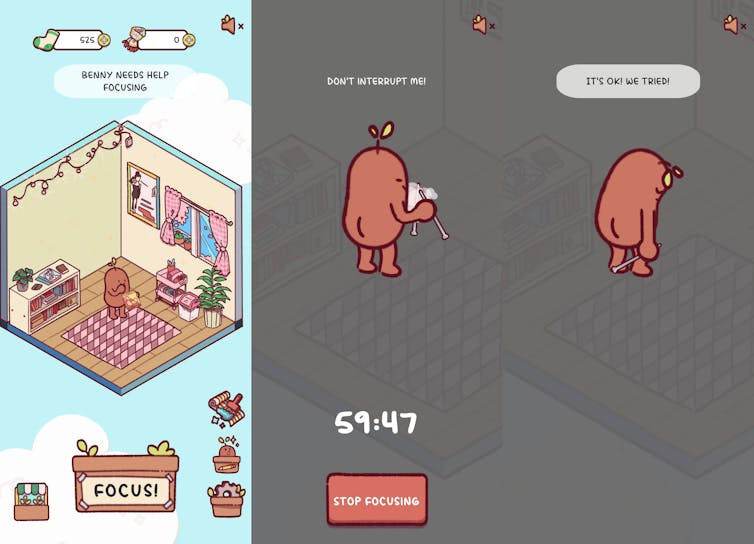
The app works by encouraging you to set a focus timer. During that session, a virtual bean character quietly knits in the background. If you pick up your phone and open apps you have pre-selected as off limits, the knitting unravels and the bean looks upset. If you stay on task, you earn digital rewards such as socks, scarves, and room decorations for your bean.
On Focus Friend, the little bean character knits happily unless you use one of the distracting apps, which makes the bean sad.The Conversation/Focus Friend
First, it uses incentives by giving you immediate, tangible rewards – knitted items and room upgrades when you complete a focus session.
Next, it leverages reward substitution by getting you to do one potentially unpleasant thing (deep work) to earn something immediately enjoyable (seeing the bean’s world improve).
The app also stimulates commitment and consistency. Simply starting the timer functions like a small promise to yourself, and once that’s made, we tend to want to behave consistently by maintaining streaks and avoiding behaviour that would break that session.
Over time, decorating the bean’s room activates the IKEA effect. That is, we place more value on things we help build, so the more you customise and invest in the space, the more motivated you become to protect it by continuing to focus.
Do focus apps actually help?
The research examining the effectiveness of focus apps is thin. One study examined a range of apps for reducing mobile phone use and found that gamified focus apps, while scoring high on user sentiment, were rarely used and were less effective than simpler strategies such as switching the phone to grayscale mode.
While no peer-reviewed studies exist specifically on Focus Friend, its high App Store ratings plus the slew of articles from enthusiastic users, suggest people enjoy using it. However, enjoyment alone does not correlate with increased focus or productivity.
How to use focus apps wisely
Do you have an automatic and uncontrollable urge to check your phone when working? If so, you could try to use a focus app.
Practical steps include scheduling specific focus sessions in which to use the app and selecting a clearly defined task. Also, when you feel the urge to check your phone mid-session, take note of the feeling and remind yourself that discomfort is part of getting important things done.
Finally, after a week of use, review your experience to see whether the app actually helped you make progress. Ask: “is this serving me, or am I serving it?”
Be sure to watch for pitfalls. Apps such as Focus Friend don’t assess the quality of your work, so you could spend focused time on low-value tasks. It’s also fairly easy to trick the app using your phone settings.
Perhaps most importantly, remember that while a focus app can help you resist checking your phone, it can’t resolve the inner forces that pull you into distraction. The key to better focus might be diagnosis, not download – that is, learning to notice what you feel, choosing how you want to respond, and making the commitment to staying focused on what matters.
Dwain Allan does not work for, consult, own shares in or receive funding from any company or organisation that would benefit from this article, and has disclosed no relevant affiliations beyond their academic appointment.
This article is republished from The Conversation under a Creative Commons license.
RUGBY The quarter-finals are set at the world darts championship - and for the first time in a non-Covid year since 2012 Michael van Gerwen won't be there More...
BUSINESS Major electricity companies are taking a big step today, towards protecting national energy security More...