Friday essay: ‘red flags’ and ‘performative reading’ – what do our reading choices say about us?
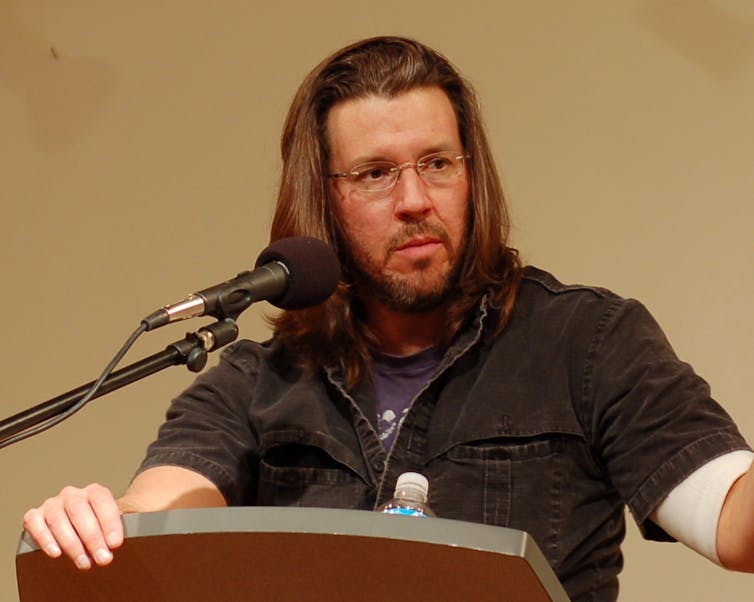
We should not close ourselves off to the possibility that a fun, charismatic David Foster Wallace fan may theoretically exist, somewhere in the world.
Julian Novitz, Senior Lecturer, Writing, Department of Media and Communication, Swinburne University of Technology
20 February 2026
What do our reading choices say about us? When teaching creative writing and literature classes, I always ask my students about their favourite genres and current reading in the first week. It is a good way to get a sense of their interests, gauge how they will respond to set texts, and get them thinking about the kinds of projects they want to work on.
There are always a few students who will sheepishly admit to not reading any fiction at all, and I’ll happily talk to them about comic books, television shows and video games. This exercise often leads to some interesting conversations across the class, where students start to connect over their favourite authors and share recommendations.
Very occasionally, however, someone will mention a book or an author that will give me pause. I still remember a moment from my second year of teaching when a student causally mentioned that they were reading The Turner Diaries, an infamous work of white nationalist speculative fiction (recently referenced in the 2024 film The Order), because they were “just curious” about it.
I didn’t press them further and the student never expressed any extremist views in class or in their writing. In fact, they were unfailingly thoughtful and respectful. I couldn’t see any evidence that this uncomfortable reading choice reflected anything about them as a person, and there are valid reasons to be curious about a book like the Turner Diaries and the warped viewpoint it presents. But it still made me feel a little cautious, in a way that I couldn’t entirely shake.
Reading as a public activity
The idea that reading – and reading fiction in particular – has a formative effect on character is generally well accepted. The books we choose to read are assumed to shape our outlook and identity, or at least reflect our values in some way. Many of us have probably slid over to a host’s bookshelves at a party and attempted to discern something about their personality and interests from the titles.
But what was once a deeply personal activity has stated to feel a lot more public. Online subcultures like Bookstagram and Booktok encourage readers to circulate and share their preferences and opinions. Platforms like Goodreads and The Storygraph allow us to follow the reading goals and experiences of friends and strangers. The once unremarkable habit of pulling out a book in a café or on public transport has now been dubbed “performative reading”, leading to a host of call-out and parody videos.
What and where we individually choose to read now seems subject to greater scrutiny. As reading becomes an increasing public act and reading identities are more extensively and visibly “performed”, we may become reasonably concerned about what our reading expresses about ourselves.
Are there books that we are proud to display and identify with? Or books that we dread being caught with in public?
Lists of supposedly “red flag” books, have been circulating for a while now, the idea being that someone’s bookshelf may reflect something problematic in their personality. These might range from very obvious red flags (e.g. Mein Kampf or the aforementioned Turner Diaries) to works that might indicate incompatible values or outlooks (most often particular genres of self-help, finance, religious or diet books, or contentious authors like Jordan Peterson and Ayn Rand). Some familiar classics and contemporary literary titles can also be taken as a warning of a particularly “toxic” reader.
This last category is invariably the most interesting. It is usually associated with male readers, in particular, and certain titles and authors get frequent mentions. Audiences are jokingly (and not so jokingly) advised to block, ghost or run from men with too many Ernest Hemingway or Charles Bukowski titles on their shelves, which may be an indicator of a particularly noxious brand of hypermasculinity. An interest in Vladimir Nabokov’s Lolita often shows up as a red flag (though this tends to assume that a reader will be sympathetic to the perspective of the narrator Humbert Humbert, rather than horrified by it).
Fans of Fyodor Dostoevsky often get stereotyped as humourless and self-serious, which, while possibly true, unfairly overlooks just how funny Dostoevsky can be. Anyone who lists David Foster Wallace’s Infinite Jest as their favourite novel may be dull or pretentious, or just unlikely to ever shut up about having read Infinite Jest.
Perhaps unsurprisingly, warnings about “red flag” books come up frequently in discussions around dating and relationship advice. Dating and social media profiles are common spaces where stated reading interests are used to convey or project one’s personality or values. Just having read or had a passing interest in particular book or author might not in itself be problematic. But the kinds of books that are listed as favourites, or even presented as a component of one’s identity, may be worth scrutinising.
Book blogger Ashley Holstrom cautions against what she characterises as “dude-bro and hippie-chick” books, such as The Bro Code by Barney Stinson or Eat, Pray, Love by Elizabeth Gilbert. Holstrom is also suspicious of classic and popular philosophy (“I’m not saying an interest in philosophy sucks or is a major red flag, but listing one of these boring-ass books as your all-time fave is”) and anyone whose personality revolves around their fandom for a massively popular series, such as Stephenie Meyers’ Twilight novels or Sarah J. Maas’ A Court of Thrones and Roses.
In all these cases, there is a suggestion that the content of these books may appeal to uninteresting, difficult or problematic people; the red flag suggests it is reader who should be avoided. But what about situations where the author’s actions or behaviour may create a red flag around reading their work?
Renouncing fandom
Just as our reading habits have become more public, authors are, in some respects, much less remote than they were previously. Rather than only expressing themselves through published books or articles, they are now encouraged to maintain a strong social media presence, with a regular stream of content.
While this certainly has its benefits, it does mean that authors – in all their virtues and flaws – are now more accessible as people than they have been in the past. Their histories and biographies are readily traceable. This may make it much harder to avoiding conflating problematic authors with their fiction.
In recent years, due to either private behaviour or public statements, a range of authors have been arguably tagged as “red flags” – in ways that may make reading or enjoying their work feel dubious or questionable. My feeds have been full of friends and acquaintances renouncing their fandom of J.K. Rowling and Neil Gaiman, among others (though the sexual assault charges against Gaiman have now been dropped, his documented behaviour remains problematic for many former readers).
As a result, there has been some extensive discussion of how we read and relate to authors whose personal views or actions we find objectionable. We may reasonably decline to support them financially through book sales, or enhance their visibility by discussing or promoting their work.
But what about public or private reading and enjoyment? One commentator suggests the best response is to sequester books by red flag author in a “corner of shame” if we are unable to discard them. Continuing to read and enjoy them is acceptable privately, but should be avoided in public. Other commentators have discussed their inability to separate the author from their work at all and have banished certain red flag authors from their shelves.
Insisting on a kind of cultural or political purity may result in overly cautious or antiseptic art. Closing ourselves off from authors or writers we disagree with may limit our perspective and frame of reference. I find David Mamet’s politics deeply disagreeable, but he remains an unmistakably great playwright and screenwriter.
At another level, continuing to read an author while aware of reprehensible actions or behaviour can be challenging. I would now find it impossible to read or recommend childhood favourite fantasy authors David and Leigh Eddings, knowing that they were tried and convicted for child abuse in the 1970s. Returning to the works of Marion Zimmer Bradley and Alice Munro, or the films of Woody Allen, now feels similarly impossible, in the light of the allegations against them.
But the cultural artefacts they created still have value, and may have meaning and resonance for new audiences who discover them.
Authors behaving badly
Our awareness of an author’s actions and biography may feel entirely at odds with the values that are expressed in their best work. It can become harder, for example, to accept Pablo Neruda as one of history’s greatest love poets after reading about his callous abandonment of his first wife and their disabled daughter.
How we understand and appreciate particular books may also shift when we learn more about the circumstances surrounding their creation. Recently, Saul Bellow’s biographers have given more attention to the collapse of his second marriage, which he loosely fictionalised in his novel Herzog.
Herzog focuses on the protagonist’s discussion of his suffering and humiliation in a series of unsent letters to public figures and dead philosophers. The letters are written after he discovers his wife has been having an affair with a close friend and wants a divorce.
Highly acclaimed at the time of its publication, Herzog cemented Bellow’s reputation as the preeminent American literary novelist of his generation. He would subsequently be awarded the Nobel Prize. But, as Louis Menand observes, Herzog is unmistakably a revenge novel. It aims to settle scores by slandering Bellow’s ex-wife Sondra, who is recognisable as Herzog’s cruel and unfaithful wife Madeleline. The protracted and repeated physical abuse that Bellow inflicted upon Sondra throughout their marriage is not mentioned.
Herzog is justly understood as Bellow’s masterwork. But an awareness of the motivations behind it, and the real stories that have manipulated or omitted through its composition, may complicate how it is read and received in 2026.
How we respond to these questions and choices is extremely personal. Authors are often as complex, human and multifaceted as their characters. It is reasonable to at least try to separate their fiction from the aspects of their personal lives and beliefs we may find unpalatable. But we may, individually, find lines we cannot cross, fictional worlds that we can never visit or return to.
It is important to emphasise that the question of what we choose to read is not the same as what we choose to buy. There may be authors and creators that we rightly feel that we can never support by purchasing their work. Consistently unimpeachable behaviour may be too high of a demand, but it is always possible to find an equally great writer who has not done awful things. Maybe buy their book instead.
But I am not comfortable with discarding red flag books and authors entirely, or confining them to some hidden “corner of shame”. The idea that our reading lists should be carefully curated to avoid projecting a particular persona also seems limiting.
Everyone reads and understands books differently, at different times in their lives. It can be fine – or even brave – to be a little curious about terrible people and unconscionable worldviews. We can have unique or different takes on particular red flags. Our knowledge of what is problematic about particular texts and authors may enhance our reading and make new understandings possible. Despite all evidence to the contrary, we should not close ourselves off to the possibility that a fun, charismatic David Foster Wallace fan may theoretically exist, somewhere in the world.
Reading is ultimately a social as well as a solitary activity. The publishing industry depends on crucial “word of mouth” discussions and personal recommendations. Sharing our reading interests, impressions and experiences – no matter how problematic or “performative” they may be – is important in keeping literacy alive. Our reading is a part of us, but it does not simply define us. We can all probably afford and accept a few “red flags” on our bookshelves.
Julian Novitz does not work for, consult, own shares in or receive funding from any company or organisation that would benefit from this article, and has disclosed no relevant affiliations beyond their academic appointment.
This article is republished from The Conversation under a Creative Commons license.
RUGBY All Blacks flanker Du'Plessis Kirifi has reported he's not far away from a return to the Super Rugby Pacific picture, but is warning his teammates not to take Moana Pasifika lightly tonight More...
BUSINESS Hopes are lifting among Auckland businesses for the economic recovery More...