A red Moon, a blue Moon, a supermoon and more: your guide to the southern sky in 2026
In 2026 we will see a total eclipse of the Moon, a blue Moon, a supermoon and the two brightest planets close together in the sky.
Nick Lomb, Adjunct Professor, Centre for Astrophysics, University of Southern Queensland
7 January 2026
What will we see in the southern sky in 2026? A total eclipse of the Moon (at a convenient time), a blue Moon and a supermoon, the two brightest planets close together, and Jupiter disappearing behind the Moon in the daytime.
All except one of these events can be seen with the unaided eye, even in light-polluted cities.
In addition to these special events, we will see the annual procession of meteor showers and the nightly parade of constellations. Though best seen from a dark country location, the most interesting of these can still be seen from cities.
Here are some of the year’s highlights.
March, May and December: the Moon
An eclipse of the Moon (or lunar eclipse) will take place on the evening of Tuesday 3 March. During the eclipse, the full Moon moves into the shadow of Earth and is likely to turn a red or coppery colour.
This is because sunlight is bent or refracted by Earth’s atmosphere onto the Moon. The bent light is red – it is the glow of sunrises and sunsets from around the globe.
Lunar eclipses are safe to watch with the unaided eye and offer a good opportunity for nighttime photography. For successful images, the camera or phone needs to be able to take timed exposures and should be firmly supported on a tripod or similar.
Seen from Australia’s south-east, totality (when the Moon is completely obscured) will occur between 10:04pm and 11:03pm local time. From Brisbane the times are an hour earlier, while from Perth the times are three hours earlier. From Aotearoa New Zealand totality will begin just after midnight.
Another lunar event is a “blue Moon” on Sunday 31 May. This is a name sometimes given to the second full Moon in a single calendar month. This happens, on average, once every two or three years.
The final Moon event is a “supermoon” on Christmas eve, Thursday 24 December. This occurs when a full Moon falls when the Moon is at the closest point to Earth in its monthly orbit.
This means the full Moon appears a little larger than usual. The supermoon looks most spectacular at moonrise, as an illusion in our brains magnifies the effect when the Moon is close to the horizon.
April, June and November: planets
Before dawn on the mornings of 19–22 April, the planets Mercury, Mars and Saturn will form a tight bunch in the sky. Look towards the east.
Mercury, Mars and Saturn form a tight bunch in the sky at 5am on April 20 – look to the east.Stellarium
On the evenings of Tuesday 9 and Wednesday 10 June, the two brightest planets, Venus and Jupiter, pass within three moon-widths of each other from our point of view.
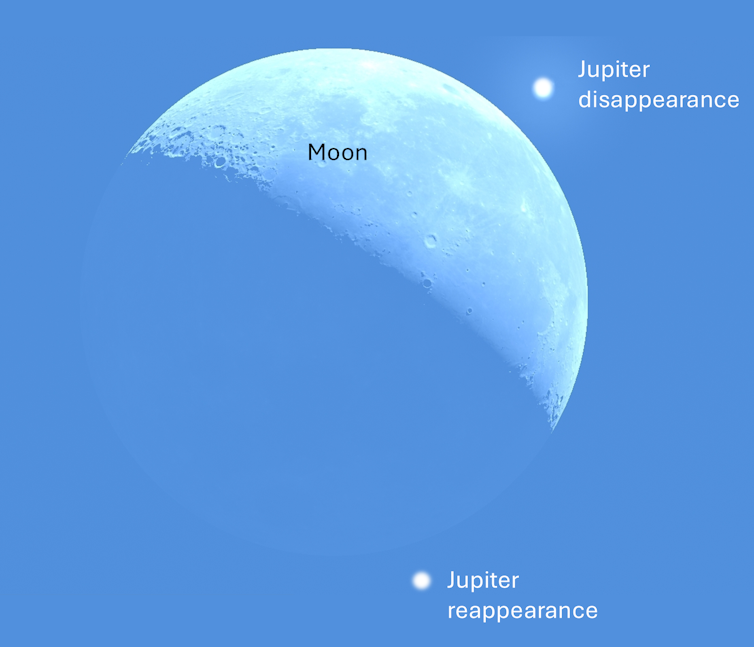
On Tuesday 3 November, the crescent Moon will pass in front of Jupiter. Although this happens during the day, it will be visible with a pair of binoculars. (Note: do not to point binoculars at the Sun! Children must be fully supervised.)
Times vary across Australia and New Zealand. From Sydney, the bright edge of the Moon covers Jupiter at 10:40am and Jupiter reappears at the dark edge at 11:39am.
The disappearance of Jupiter behind the Moon and its reappearance in the daytime sky of November 3 2026.Stellarium/Nick Lomb, CC BY
December: meteor shower
Before dawn on mornings in mid-December, there is a favourable opportunity to view the Geminid meteor shower, one of the best such showers during the year. The shower occurs when the Earth runs into a stream of dust left behind by a rocky asteroid called Phaethon.
As the dust particles burn up in the atmosphere 100km or so above our heads, brief streaks of light called meteors can be seen. This year there is a good chance to see them, as the Moon will not brighten the sky.
This year, the peak of the shower is predicted for the early morning of Tuesday 15 December. To see the meteors, try to find the darkest spot you can, and look towards the north as shown below. The meteors will appear to radiate from a point near Castor, in the Gemini constellation.
The night sky as seen from Toowoomba at 4am on 15 December 2026. The stars Castor and Pollux in the constellation Gemini are seen high to the north.Stellarium
January and December: Taurus
Many of the constellations in the European tradition, visible from the northern hemisphere, were named in ancient times. Explorers and astronomers venturing south of the equator in the 18th century named most of the rest.
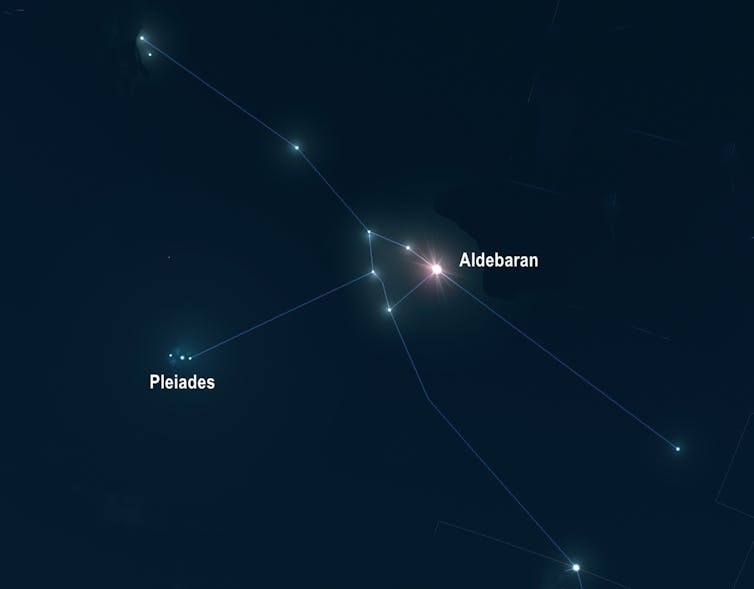
The best way to find Taurus is to extend a line downwards from the three stars of Orion’s belt until you reach a bright reddish star called Aldebaran.
Aldebaran sits in an inverted V-shaped group of stars. This is the Bull’s head, upside down for us as it was named in the northern hemisphere. The other stars in the group are part of a cluster called the Hyades.
The main stars of the constellation of Taurus, the Bull.Nick Lomb, CC BY
Another cluster in Taurus is the Pleiades. This is named the Seven Sisters, not just in the European tradition, but by cultures around the world, including First Nations people of Australia.
With the unaided eye, most people can only see six stars in this compact cluster, but hundreds can been seen through a telescope. In 2025 astronomers found the Pleiades likely contains 20 times as many stars as previously thought.
The information in this article comes from the 2026 Australasian Sky Guide. The guide has monthly star maps and more information to help with viewing and enjoying the night sky from Australia and Aotearoa New Zealand.
Nick Lomb has received author's fees for the 2026 Australasian Sky Guide
This article is republished from The Conversation under a Creative Commons license.
RUGBY The Pittsburgh Steelers are counting on their 42-year-old off-season acquisition to pay dividends in their home NFL playoff wildcard matchup against Houston More...
BUSINESS Concern persistent tough economic conditions are impacting young people's employment opportunities More...