Frida Kahlo’s record-breaking painting El Sueño positions death as a roommate
Art and the body are often linked in Kahlo’s life, which was short and traumatic.
Benedict Carpenter van Barthold, Lecturer, School of Art & Design, Nottingham Trent University
1 December 2025
Frida Kahlo’s 1940 self-portrait, El Sueño (La Cama), or The Dream (The Bed), has sold for US$54.7 million (£41.4m) at Sotheby’s New York. It is now the most expensive Latin American artwork in history, and has set the auction record for a female artist.
Kahlo’s canvas was the standout lot in a collection titled Surrealist Treasures. The painting appears to be a quintessential surrealist nightmare: a skeleton stalking a sleeping woman. But there is more to Kahlo’s work than the surrealist label might imply.
The painting (which is 74x98 cm) shows a four-poster bed floating in a cloudy sky. The perspective is disquieting. The bed tilts away from the viewer, as though seen from below. The upper part of the painting, where the skeleton lies, is light and airy. Its elbow almost touches the upper edge of the canvas, suggesting the structure is floating upward. The bottom tier, occupied by Kahlo, appears heavier. The cloudy backdrop is more threatening and the palette is earthier.
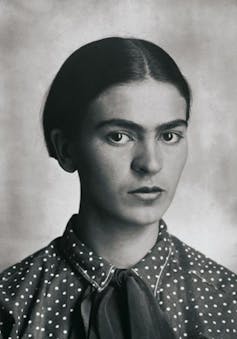
Frida Kahlo as photographed by her father in 1926.Wiki Commons
Kahlo sleeps under a blanket covered with a plant motif, something like a thorned and blossomless rose. The vines escape the confines of the blanket to surround her head. Curling roots can be seen at her feet. Implicitly, her body is anchored, like the plant, in cycles of growth and decay, a theme familiar from other paintings.
The two figures, death and life, mirror each other. Their heads face the same way, with two pillows under each. The skeleton is covered with wired explosives, mimicking the twining stems and roots. He holds a bouquet of flowers in his left hand, like a suitor.
The skeleton is not a surreal invention. It is a Judas figure, a painted papier-mâché “guy”, a real object from Kahlo’s collection.
In Mexico, these figures are personifications of evil that are burned or exploded on Holy Saturday, the day before Easter Sunday, in a symbolic triumph over evil. Their destruction, a brief spin of sparks, ends in an almighty bang. This Judas figure also resembles a calaca, a skeleton from the Mexican Day of the Dead. Its apparently bizarre placement on the canopy of Kahlo’s colonial-era four-poster bed is how it was displayed in her home. This is death as a roommate.
The composition reminds me of a “double-decker” late medieval cadaver tomb. These European tombs show the deceased, recumbent on the top layer as in life, and below, their skeleton or rotting corpse. Here, in an inversion of that layering, death appears to be an escape: from earth, to foliage, to flower, to sky. Furthermore, the way the bed imposes a grid on the painting is structurally similar to a Mexican retablo or “miracle painting”.
These typically depict a moment of miraculous recovery, or rescue from danger, accompanied by a dedication to an intervening saint. Kahlo adapts this format by substituting the saint with the Judas figure, moving from the reality of her body to a world of tradition, signs, symbols.
Art and death
Art and the body are often linked in Kahlo’s life, which was short and traumatic (she died in 1954 aged 47).
She contracted polio aged six, which left her with a stunted leg. At 18, she was terribly injured when the bus she was riding collided with a tram. An iron bar pierced her lower back and exited through her abdomen, damaging her spine and several organs. She required more than 30 operations throughout her life. Yet this incident was also her birth as an artist. Confined to bed for months, her body in a plaster corset, as stiff and white as the skeleton in this painting, she began to paint.
Frida Kahlo aged 11, five years after contracting polio.Museo Frida Kahlo
In addition to physical anguish, her marriage to the celebrated muralist Diego Rivera was fraught. She suffered multiple failed pregnancies. The pair separated for a year when she discovered his infidelity with her younger sister, Cristina.
The bed, a site of convalescence and recovery, is a frequent motif in Kahlo’s work. Her constant physical and psychological pain is a central subject in her art. But this doesn’t come from dreams, conjured from automatic drawing, or psychological play as it was for many of the surrealists. Her art reflects a life defined by events that exceed the human norm of what is tolerable. In El Sueño, the Judas figure is a symbol of incipient pain – a double, a lover and a complex form of promised escape. She is asleep, but he’s awake.
This context firmly distances her work from the European surrealists. Kahlo herself had a difficult relationship with the movement. André Breton, the “pope of surrealism”, lauded her, saying that “the art of Frida Kahlo is a ribbon around a bomb”. But Kahlo found the surrealists fake, complacent and badly organised. In a ferocious 1939 letter to the photographer Nickolas Muray, she stated:
I would rather sit on the floor in the market of Toluca and sell tortillas, than have anything to do with those ‘artistic’ bitches of Paris … they live as parasites of the bunch of rich bitches who admire their ‘genius’ of ‘Artists’. Shit and only shit is what they are.
Years later, she was more measured: “They thought I was a surrealist, but I wasn’t. I never painted dreams. I painted my own reality”. Kahlo’s work, combining realism with myth and cultural specificity, is better described as the marvellous real: experience grounded in her own culture of Mexico – and experience of pain.
Looking for something good? Cut through the noise with a carefully curated selection of the latest releases, live events and exhibitions, straight to your inbox every fortnight, on Fridays. Sign up here.
Benedict Carpenter van Barthold does not work for, consult, own shares in or receive funding from any company or organisation that would benefit from this article, and has disclosed no relevant affiliations beyond their academic appointment.
This article is republished from The Conversation under a Creative Commons license.





.jpg)