I wrote a book on the politics of war powers, and Trump’s attack on Venezuela reflects Congress surrendering its decision-making powers
Congress has a legal, constitutional and even moral responsibility to assert itself as a branch when it comes to military actions by the US, says an expert on war powers.
Sarah Burns, Associate Professor of Political Science, Rochester Institute of Technology
4 January 2026
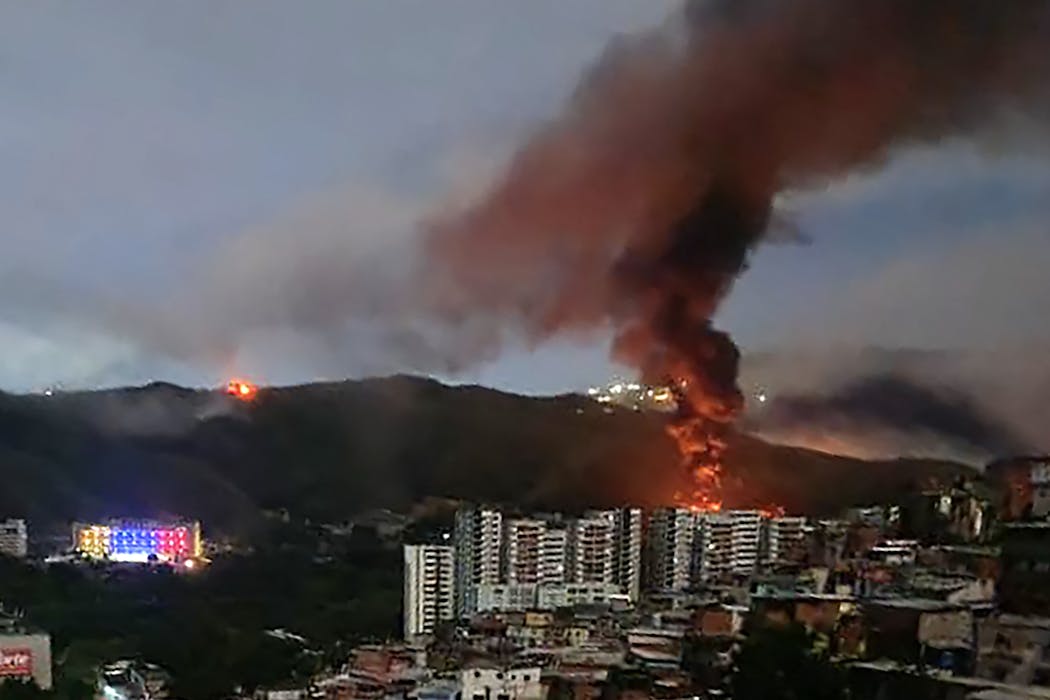
Explosions were seen across Caracas after the U.S. launched large-scale attacks on Venezuela and captured its leader and his wife.
AFP via Getty Images
Americans woke up on Jan. 3, 2025, to blaring headlines: “US CAPTURES MADURO, TRUMP SAYS,” declared The New York Times, using all capital letters. The U.S. had mounted an overnight military raid in Venezuela that immediately raised questionsof procedure and legality. Prime among them was what role Congress had – or should have had – in the operation.
Politics editor Naomi Schalit interviewed political scientist Sarah Burns, author of the book “The Politics of War Powers” and an expert at Rochester Institute of Technology on the historical struggle between Congress and U.S. presidents over who has the power to authorize military action.
Is this a war?
I wouldn’t call it a war. This is regime change, and whether or not it has a positive impact on the United States, whether or not it has a positive impact on Venezuela, I think the likelihood is very low for both of those things being true.
How does Congress see its role in terms of military action initiated by the United States?
So you see some effort on the part of Congress to assert itself in the realm of war. But it failed predominantly on party lines, with Democrats saying we really don’t want to go into Venezuela. We really don’t want to have this action. Republicans predominantly were supporting the president and whatever it happens to be that he would like to do. Moderate Republicans and Republicans who are in less safe districts were and are more likely to at least stand up a little bit to the president, but there’s a very small number of them.
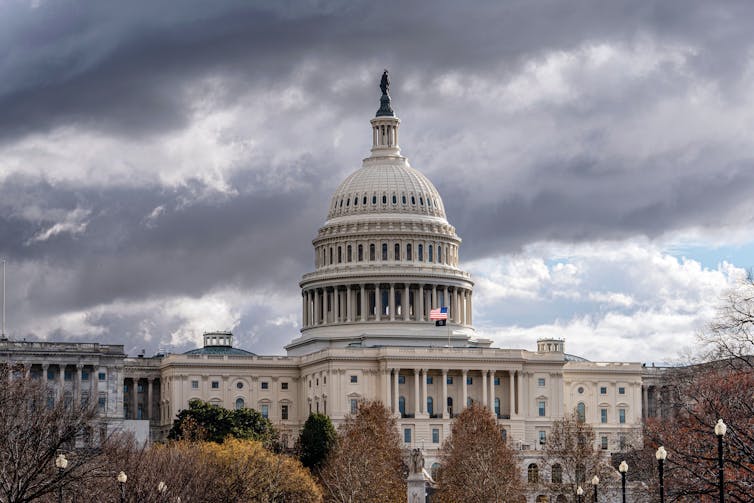
Congress has been largely absent as President Donald Trump has escalated his verbal and military attacks on Venezuela.AP Photo/J. Scott Applewhite
So there may be an institutional role for Congress, a constitutional role, a role that has been confirmed by legal opinion, but politics takes over in Congress when it comes to asserting its power in this realm?
That’s a perfect way of putting it. They have a legal, constitutional, one might even say moral, responsibility to assert themselves as a branch, right? This is from Federalist 51 where James Madison says “Ambition must be made to counteract ambition.” So it should be that as a branch, they assert themselves against the president and say, “We have a role here.”
In the 1940s, presidential scholar Edward Corwin said that in the realm of foreign policy, it is an invitation for Congress and the president to struggle. So it should be that Congress and the president are struggling against each other to assert, “I’m in charge.” “No, I’m in charge.” “No, I’m in charge,” in an effort to create a balance between the two branches and between the two things that each of the branches does well. What you want from Congress is slow deliberation and a variety of opinions. What you want from the president is energy and dispatch.
So certainly, if we have an attack like 9/11, you would want the president to be able to act quickly. And you know, conversely, in situations like the questions around what the U.S. is doing in Venezuela, you want slow deliberation because there is no emergency that requires energy and dispatch and speed. So the president shouldn’t be entirely in the driver’s seat here, and Congress should very much be trying very hard to restrain him.
One of the things that members of Congress have attempted to do several times, with very little positive impact, is go to the courts and say, “Can you restrain the president?” And political scientist Jasmine Farrier has written that the courts have regularly said to members of Congress: “You have the power to stop the president, and you are ineffective at that. And so if you want to stop the president, you shouldn’t turn to us. You should work together to create legislation that would restrain the president.”
What would such legislation do? Cut off money for troops? Is it finger-wagging, or is it something really concrete?
There are a few different tiers. Joint resolutions are finger-wagging. They just say, “Bad, Mr. President, don’t do that.” But they have no effect in law.
The War Powers Resolution, first passed in 1973, is a legitimate way of trying to restrain the president. Congress intended to say to presidents, “You cannot start a war and continue a war without our authorization.” But what they said instead was “You could have a small war or a short war – of 60 to 90 days – without our authorization, and then you have to tell us about it.” That just sort of said to presidents the opposite of what they intended. So President Barack Obama took advantage of that with the military engagement in Libya, as well as Trump in his first administration.
This is not a partisan issue. It’s not Republican presidents who do it. It’s not Democratic presidents who do it. It’s every president since the War Powers Resolution was passed, and the only time that Congress has drawn down troops or drawn down money was the Vietnam War.
Other than that disastrous war, we have not seen Congress willing to put themselves on the politically negative side, which is taking money away from the troops. Because if you take away money right now, they’re going to be harmed.
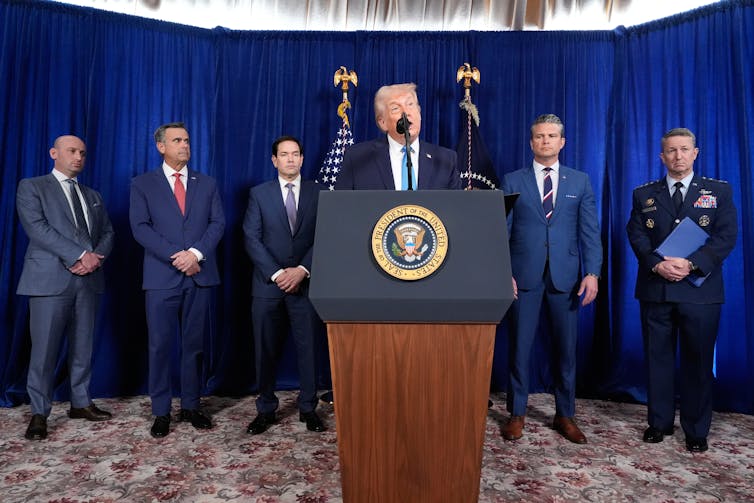
President Donald Trump and his national security team discuss the U.S. strikes on Venezuela at his Mar-a-Lago club in Palm Beach, Fla., on Jan. 3, 2026.AP Photo/Alex Brandon)
What is the War Powers Resolution?
The War Powers Resolution from 1973, also known as the War Powers Act, was Congress – during the Vietnam War – saying definitively to President Richard Nixon, “You have overstepped your bounds.” They had explicitly said in law, you cannot go into Cambodia. And Nixon went into Cambodia.
So that was their way of trying to reassert themselves very aggressively; as I mentioned before, it didn’t work effectively. It worked insofar as presidents don’t unilaterally start wars that are large scale, the way that World War II was large scale. But they do have these smaller actions at varying levels.
Then we get to 9/11 and we see the 2001 authorization for the use of military force, and the 2002 authorization for the use of military force. The 2001 law authorized going after anyone in al-Qaida and associated with 9/11. The 2002 authorization was directly related to Iraq, saying “There is a problem with Iraq, we have to do something.” Both of them were extremely vague and broad, and that’s why we’ve seen four presidents, including Trump, using the 2001 and 2002 authorizations to carry out all sorts of operations that had very little to do with Saddam Hussein or al-Qaida.
In 2021, senators Mike Lee, Bernie Sanders and Chris Murphy collectively got together and tried to create a national security document that would restrain presidential unilateralism. It was a good effort on the part of members of Congress from a variety of different ideological views to attempt to restrain the president. It did not even sort-of pass – it barely got out on the floor.
Since that time, we haven’t seen a lot of efforts from members of Congress. They haven’t really reasserted themselves since the war in Korea, which began in 1950. It’s very clear that ambition is no longer checking ambition the way that it was meant to by the founders.
When you woke up this morning and saw the news, what was your first thought?
Here we go again. This is not a Republican or a Democratic issue. Lots of presidents have made this error, which is that they think if you do this smaller-scale action, you are going to get a positive result for the nation, for the region, for international stability. And very rarely is that the case.
Sarah Burns does not work for, consult, own shares in or receive funding from any company or organization that would benefit from this article, and has disclosed no relevant affiliations beyond their academic appointment.
This article is republished from The Conversation under a Creative Commons license.
RUGBY The Seattle Seahawks have locked up top seed in American football's NFC with a 13-3 win over the San Francisco 49ers More...
BUSINESS The Deputy Privacy Commissioner is urging people whose data may have been compromised in major breaches - to take immediate precautions More...