Vinegar Valentines: how cruel Victorians sent insulting cards to their unwanted suitors
The vile Victorians were funnier than they looked, using brutal Valentine’s Day cards to mock people they didn’t fancy much.
Grace Marks, Graduate Teaching Assistant in History and English Literature, Edge Hill University
13 February 2026
Many people imagine the Victorians to be the stern “we are not amused” type, yet they had a pretty cruel sense of humour when it came to Valentine’s Day. While today’s lovers often exchange cute (and cheesy) cards, the Victorians loved to send insulting “vinegar Valentines”.
I first discovered this peculiar practice in 2019, when I designed a small exhibition at The Atkinson arts hub in Southport as part of a larger show about Victorian humour. Researching the cards was eye-opening and a lot of fun, and I think of them every Valentine’s Day when I look at the more sentimental and affectionate fare on sale now.
Posted to unwanted suitors or people one disliked, vinegar Valentines were cheaply produced cards with unflattering images and offensive poems. These anonymous illustrations and verses were intended to represent the unfortunate recipient and point out their flaws, as well as leaving them guessing who sent it.
The last word in bad romance, these mock valentines were particularly popular in Britain and America from the 1840s onwards. They featured many different types of caricatures.
Some cards focused on the recipient’s looks, exaggerating or shrinking facial features to look as unpleasant as possible. The illustration above depicts a women with squashed, unappealing features – and the accompanying verse highlighted these flaws. The rhyme, A Beanery Beauty, states:
Though nothing more homely e’er walked on two feet,
In your own mind you’re everything lovely and sweet,
That you’re not a heart-breaker’s a fact I’d impart –
You may break lots of dishes, but nary a heart.
The card lampoons the recipient’s presumptions that she is attractive and good-tempered. However, the verse cuts through the supposed good opinion the lady has of herself by asserting that she would never be admired enough to be loved. The line describing how she “may break lots of dishes, but nary a heart” is the zinger. Not only is the poor woman deemed unattractive, she’s clumsy too.
This chap’s bad behaviour has definitely been rumbled.CC BY
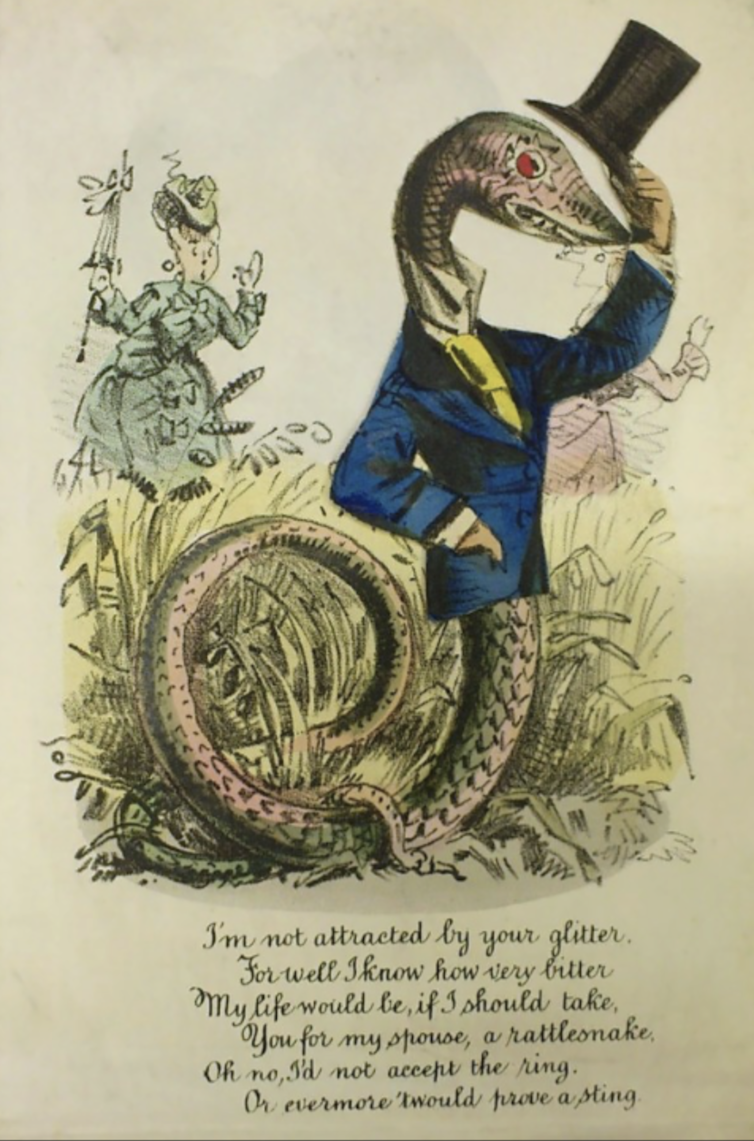
Women were not the only recipient of Valentine’s Day hate mail – men were denigrated if considered to be unappealing flirts. A common feature of vinegar Valentines was to depict the recipient as an animal. My favourite features a snake in a blue smoking jacket with a black top hat, and a horrified lady in the background.
The accompanying poem states the man is a “rattlesnake”, hence the image, and describes the “bitter” life a lady would lead with the recipient as a spouse. It ends with the cautionary line that a lady would “not accept the ring / Or evermore ‘twould prove a sting”.
These cards were phenomenally popular and demonstrate what happens when love goes wrong. But how did Victorians actually meet their potential spouses?
A Victorian version of online dating
A new method of courtship in the Victorian era was placing a matrimonial advert in a newspaper or periodical. These advertisements were much like a modern-day dating profile, where readers would submit their “bio” to the paper and wait for it to be published.
One paper that regularly featured matrimonial adverts was Ally Sloper’s Half-Holiday, an illustrated weekly that focused on the leisure pursuits of the late-19th century.
An early version of the comic strip, the Half-Holiday established an enormous readership, reaching 340,000 people. Most stories followed the fictional exploits of idle schemer Ally Sloper, who skulked and sloped about the alleyways of East London in the late 19th century. The “half-holiday” referred to the half day on a Saturday when people were free to indulge in leisure activities, and which for many coincided with football matches.
The dodgy Sloper was the main recurring character, but the paper also regularly featured his glamorous daughter, a music-hall actress and founder of Tootsie’s Matrimonial Agency. The paper liked to pretend their fictional characters were a genuine family, and offered real services to their readers. As the most romantic character, Tootsie Sloper was the natural figurehead for romance-seeking readers. Hopeful advertisers often described themselves as “fond of fun” and wanted their partners to be “jolly”.
Others played with humour in their ads, like the “Two Young Gentlemen” who described themselves to be “not painfully repulsive, but not precisely dangerously handsome”. Despite fears that dating adverts were full of scammers – much like catfishing today – they provided a novel way for partners to meet, and allowed regular readers the fun of speculating about the advertisers.
Victorians were not the perpetually grim-faced, serious bunch that old photographs often make out. They were fun-loving people who enjoyed playing practical jokes on one another. Matrimonial adverts allowed Victorian lovers to have more control over how they presented themselves to potential partners, and express their humour for all to see.
Vinegar Valentines were one of many ways the Victorians shared their sense of humour, while rejecting any unwanted attention. Insulting in nature, these cards were were intended to make the recipient feel foolish, much like the jokes found in comic papers at the time.
But spare a thought for the poor souls who received one of these cruel cards before the era of prepaid postage. They had to pay to receive their insults!
Grace Marks does not work for, consult, own shares in or receive funding from any company or organisation that would benefit from this article, and has disclosed no relevant affiliations beyond their academic appointment.
This article is republished from The Conversation under a Creative Commons license.