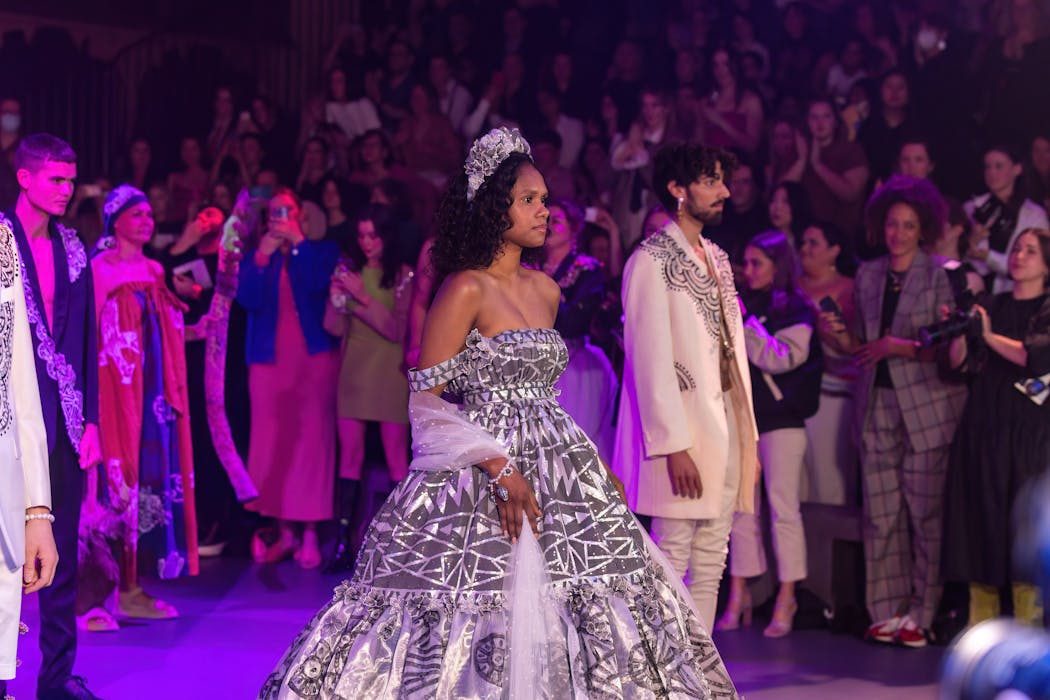
How fashion designer Paul McCann reimagines the Indigenous debutante ball
Marrithiyel artist and designer Paul McCann traces past, present, and imagined futures of the Indigenous debutante tradition
Treena Clark, Chancellor’s Indigenous Research Fellow, Faculty of Design and Society, University of Technology Sydney
19 November 2025
Michael Currie/SOPA Images/LightRocket via Getty Images
Aboriginal and Torres Strait Islander peoples are advised that the following article contains images and voices of deceased persons.
Marrithiyel artist and designer Paul McCann defines fashion as armour. Wearing his own creations allows him to feel protected while centring culture and claiming presence.
McCann describes himself as having “faboriginal flair,” a phrase that captures both the playful and cultural essence of his work.
His celebrated gumnut dress embodies this approach of translating cultural motifs into high fashion. Worn by Gamilaroi and Dunghutti drag queen Felicia Foxx at Australian Fashion Week 20221, the gown was a moment of spectacle and subversion on the runway.
It is through this same lens that McCann traces past, present, and imagined futures of the Indigenous debutante tradition in Warrnambool Art Gallery’s new exhibition The Regional.
The start of debutante balls
In 1780 England, King George III hosted a ball for his wife Queen Charlotte in honour of her birthday and as a fundraising event. Young women of the elite curtsied to the queen, who stood by a giant birthday cake.
As these annual balls continued, the young women were also presented to society to signal marriage eligibility and social season readiness.
In the mid-20th century, Indigenous communities took on these traditions and updated them with cultural meanings. One such way was decorating the room and themselves with cultural designs such as boomerang bouquets.
These Indigenous debutante balls claimed presence, resilience and cultural practice. They were especially significant in regional areas, where racism was an everyday reality.
Against this backdrop, the first Indigenous debutante ball in Naarm/Melbourne in 1949 carried particular weight. Many of the young women presented to Sir George and Lady Knox had travelled from country districts.
These early, often regional, events laid the groundwork for what would become an evolving and political occasion in the years to follow.
A political and empowering experience
From the mid-1960s, Indigenous debutante balls became more formal and structured. They also often served as community fundraisers, particularly for regional Indigenous communities.
The NSW Foundation for Aboriginal Affairs’ 1968 Warrane/Sydney debutante ball marked a turning point. The 1968 ball was highly political, shaped by both Indigenous and white activists and politicians, including Prime Minister John Gorton.
Held just seven weeks after the successful 1967 referendum, which acknowledged First Nations people as equal citizens, the ball was described by the media as “the symbolic coming out of all Aboriginal people”.
Some Indigenous community members saw this ball as empowering. Other members criticised it as promoting white ideals. Many young Indigenous people remembered it simply as a night to be together and celebrate.
These reworkings show how various communities are reshaping debutante balls into spaces of identity, belonging and celebration.
McCann’s work weaves the lineage of debutante balls from their early origins, through mid-century Indigenous versions, to contemporary reinterpretations.
A deeply personal reference in the exhibition is McCann’s grandmother, Elizabeth, and the recreation of her 1950s debutante gown.
He discovered her debutante history through photographs and clippings. This connection leads the exhibition through both personal and collective Indigenous histories.
Alongside this reimagined piece, the exhibition showcases McCann’s signature Indigenous glamour in his existing gowns. These contemporary debutante dresses retain the colonial, white tradition yet are culturally updated with Indigenous designs.
His tailored men’s jackets extend this reinterpretation, highlighting the role of the male partners and celebrating diverse expressions of identity.
McCann’s exhibition weaves through time and space, envisioning both what Indigenous debutantes might have worn in the past and what they could wear in the years ahead.
Honouring the past, present and future
McCann’s work in The Regional opens up conversations about colonial and reimagined debutante scenes. It also reflects on family loss and honouring legacies.
Developed with architects Studio Bright, the exhibition space evokes a ballroom, immersing visitors in McCann’s cultural, historical and personal world.
Velvet curtains, dramatic lighting, mannequins, and Indigenous-painted plinths honours both historical and contemporary Indigenous debutante traditions.
This transformed ballroom space offers visitors a chance to feel the glamour and magic of being centre stage. To reimagine the debutante ball as a place of belonging, beauty, and cultural practice.
In doing so, McCann reminds us fashion operates as both a story and armour for many people and communities, notably the Indigenous debutantes such as his grandmother.
This is an edited extract from Treena Clark’s essay on Paul McCann’s exhibition in The Regional, commissioned by the Warrnambool Art Gallery. The Regional is on now.
Treena Clark has received funding through the University of Technology Sydney Chancellor’s Indigenous Research Fellowship scheme.
This article is republished from The Conversation under a Creative Commons license.