Ayatollah Ali Khamenei has ruled Iran with defiance and brutality for 36 years. For many Iranians, he will not be revered
Khamenei will largely be remembered for the profound weakness his leadership brought the Islamic Republic.
Andrew Thomas, Lecturer in Middle East Studies, Deakin University
1 March 2026
Ayatollah Ali Khamenei, Iran’s supreme leader for 36 years, has been killed in US and Israeli airstrikes on his country, according to US President Donald Trump. Iran did not immediately confirm his death.
As one of Iran’s longest-serving leaders, Khamenei has been almost as ubiquitous in Iranian society as his predecessor, Ayatollah Ruhollah Khomeini, who founded the Islamic Republic of Iran in 1979.
And despite the fact Khomeini authored the Iranian Revolution, some say Khamenei was actually the most powerful leader modern Iran has had.
In more than three decades as supreme leader, Khamenei amassed unprecedented power over domestic politics and cracked down ever more harshly on internal dissent. In recent years, he prioritised his survival – and that of his regime – above all else. His government brutally put down a popular uprising in December 2025–January 2026 that killed thousands.
Ultimately, though, Khamenei will not be remembered by most Iranians as a strong leader. Nor will he be revered. Instead, his legacy will be the profound weakness his regime brought the Islamic Republic on all fronts.
Khamenei’s rise through the ranks
Khamenei was born in the city of Marshad in northeastern Iran in 1939. As a boy, he began to form his political and religious world view by studying at Islamic seminaries in Najaf and Qom. At 13, he started to embrace ideas relating to revolutionary Islam. These included the teachings of cleric Navab Safavi, who often called for political violence against the rule of the shah of Iran, Mohammad Reza Pahlavi.
Khamenei met Khomeini in 1958 and immediately embraced his philosophy, often referred to as “Khomeinism”.
The concept of velayat-e faqih, also known as guardianship of the jurist, is central to Khomeinism. It dictates that the supreme leader should be endowed with “all the authorities that the Prophet and infallible Imams were entitled”.
Essentially, this means Iran was to be ruled by a single scholar of Shia Islam. This is where Khomeini, and later Khamenei, would draw their sweeping power and control.
From 1962, Khamenei began almost two decades of revolutionary activity against Pahlavi (the shah) on behalf of Khomeini, who was exiled in 1964. Khamenei was arrested by the shah’s secret police in 1971 and tortured, according to his memoirs.
When the shah was overthrown in the Islamic Revolution in 1979, Khomeini returned from exile to become the new supreme leader.
Khamenei was selected to join the Revolutionary Council, which ruled alongside the provisional government. He then became deputy defence minister and assisted in organising the Islamic Revolutionary Guard Corps (IRGC). This military institution – initially created to protect the revolution and supreme leader – would become one of the most powerful political forces in Iran.
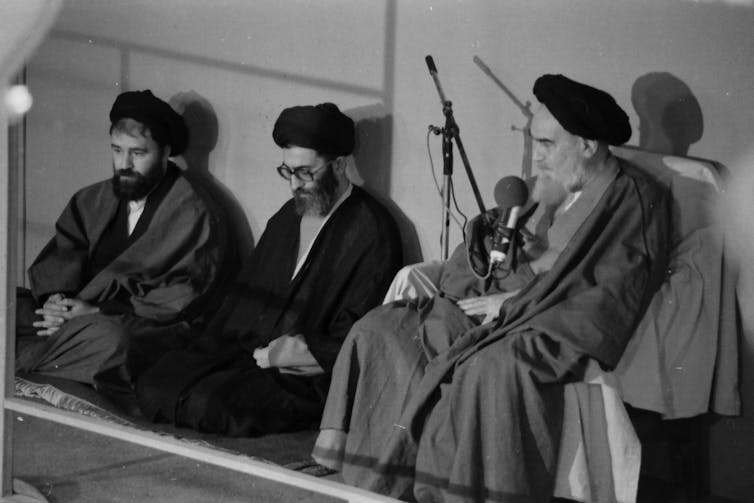
Ayatollah Ruhollah Khomeini (sitting on chair), Ali Khamenei (middle), and Khomeini’s son, Ahmad Khomeini (left), pictured in 1981.Wikimedia Commons
Although subordinate to the supreme leader, Khamenei wielded significant power compared to later presidents, given the revolution was still very young and the Iraq war posed a great threat to the regime. But he remained in lock-step with Khomeini’s wishes. He also managed to build a close relationship with the IRGC that would go far beyond his presidency.
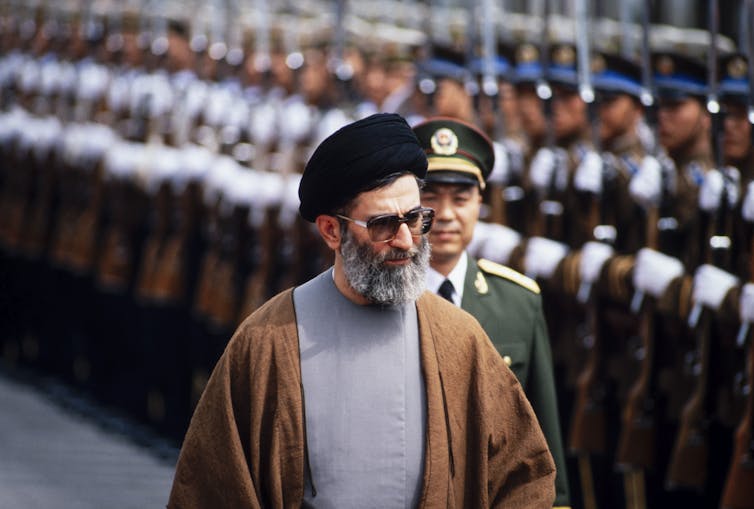
Then-President Ali Khamenei during a state visit to China in May 1989.Forrest Anderson/Getty Images
A surprising choice for supreme leader
Khomeini died in June 1989 after a period of deteriorating health, with no clear successor.
Khomeini had initially supported Grand Ayatollah Hossein-Ali Montazeri to be his successor. However, Montazeri had become increasingly critical of the supreme leader’s authority and human rights violations in the country. He resigned in 1988 and was put under house arrest until his death in 2009.
In fact, his appointment sparked a significant amount of controversy and criticism. Some Islamic scholars believed he lacked the clerical rank of grand ayatollah, which was required under the constitution to ascend to the position. These critics believed the Iranian people would not respect the word of “a mere human being” without a proper connection to God.
The constitutional amendments, however, had given Khamenei significantly more power to intervene in political affairs. In fact, he had far more power as supreme leader than Khomeini ever enjoyed.
This included the ability to determine general policies, appoint and dismiss members of the Council of Guardians, and order public referendums. He also had enough power to silence dissent with relative ease.
Consolidating power over the decades
Khamenei worked with his presidents to varying degrees, though he exercised his power to undermine legislation when he disagreed with it.
For example, he largely backed the economic agenda of President Hashemi Rafsanjani (who served from 1989 to 1997), but he often stood in the way of Mohammad Khatami (1997–2005) and Hassan Rouhani (2013–21). Both had attempted to reform Iran’s political system and foster a better relationship with the West.
Khamenei’s most famous intervention in domestic politics occurred after the first term of President Mahmoud Ahmadinejad (2005–13). After Ahmadinejad claimed victory in the disputed 2009 presidential election, thousands of Iranians took to the streets in one of the largest protest movements since the revolution. Khamenei backed the election result and cracked down harshly on the protesters. Dozens were killed (perhaps more), while thousands were arbitrarily arrested.
Khamenei later clashed with Ahmadinejad and warned him against seeking the presidency again in 2017. Ahmadinejad defied him, but was later barred from running.
After the death of hardline President Ebrahim Raisi in a helicopter crash in 2024, Khameini continued his manoeuvring behind the scenes. After the reformist Masoud Pezeshkian won the presidency, Khameini immediately blocked him from negotiating with the United States over sanctions relief and used his influence to thwart his economic reform agenda.
Thanks to the powers vested in him in the constitution, Khamenei also had extraordinary control over Iran’s foreign policy.
Like his mentor, Khomeini, he staunchly supported the regime’s resistance to what it considered “Western imperialism”. He was also a key architect of Iran’s regional proxy strategy, funding militant groups like Hezbollah, Hamas, the Houthis and others to carry out Iran’s military objectives.
During the first Trump administration, however, Khamenei returned to a staunchly anti-Western posture. His government railed against Trump’s scuttling of the 2015 nuclear deal, the reimposed economic sanctions on Iran’s energy sector and the assassination of the head of the IRGC’s Quds force, Qassem Soleimani.
After Trump returned to office in 2025, Iran grew even weaker. And Khamenei’s anti-Western posture began to look increasingly hollow. Iran’s defeat in the 12-day war with Israel in 2025 shredded whatever legitimacy his regime had left.
In the months that followed, Khamenei ruled over a population increasingly resentful of the Iranian political system and its leadership. In the 2025–26 protests, some openly chanted for Khamenei’s death.
When Khomenei died in 1989, his state funeral was attended by millions. Mourners pulled him out of his coffin and scrambled for sacred mementos.
Though Khameini served longer, Iranians will likely not show the same grief for him.
Andrew Thomas does not work for, consult, own shares in or receive funding from any company or organisation that would benefit from this article, and has disclosed no relevant affiliations beyond their academic appointment.
This article is republished from The Conversation under a Creative Commons license.
RUGBY The Hurricanes have confirmed Brett Cameron has been ruled out for the rest of Super Rugby More...
BUSINESS It's been revealed UK supermarket giant Tesco, declined the Finance Minister's invitation for a meeting to discuss the issues in our grocery sector More...