Gold clam invasion in NZ threatens drinking water for millions of people
The invasion threatens more than water. Clams could foul dam intakes and reduce hydroelectric efficiency in a river that generates 13% of New Zealand’s power.
Adam Hartland, Adjunct Associate Professor, Lincoln University, New Zealand
2 December 2025
As a geochemist studying New Zealand’s freshwater systems, I’ve spent years tracking the subtle chemical shifts in our rivers and lakes.
But nothing prepared me for the rapid transformation unfolding in the Waikato River since the invasion of the Asian clam (Corbicula fluminea, also known as the freshwater gold clam).
First detected in May 2023 in Lake Karapiro, a reservoir lake on the Waikato, this bivalve is now altering the river’s chemistry in ways that could jeopardise drinking water for up to two million people, disrupt hydroelectric power and undermine decades of ecosystem restoration efforts.
Our team’s work reveals how these clams are depleting essential minerals like calcium from the water, impairing arsenic removal during treatment and signalling a rapid escalation with broader impacts ahead.
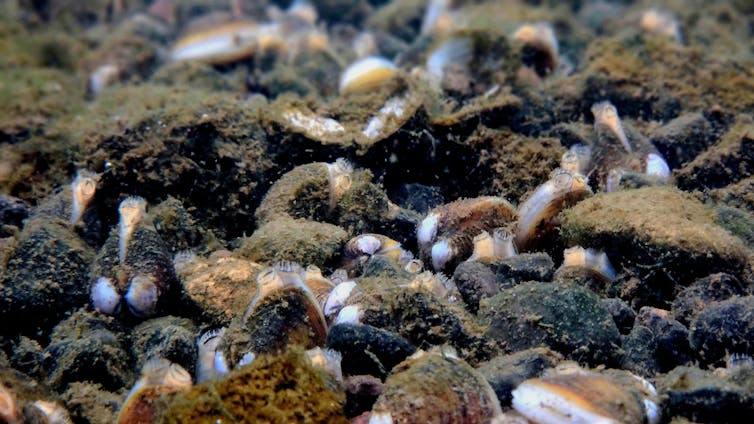
Gold clams now dominate the river bed in many areas, with densities exceeding 1,000 individuals per square metre.Michele Melchior, CC BY-ND
Native to eastern Asia, the gold clam can self-fertilise and spreads via contaminated gear, birds or floods. Climate change will likely accelerate its invasion.
The problem is already spreading quickly beyond the Waikato River. A recent detection in a Taranaki lake has led to waterway closures. And warnings for the Whanganui River underscore the urgent need for national vigilance.
A silent invasion with big consequences
The Waikato River stretches 425 km from Lake Taupo to the Tasman Sea, powering nine hydroelectric dams and supplying drinking water to Auckland, Hamilton and beyond.
It’s a taonga (cultural treasure) central to Maori identity and the subject of a landmark restoration strategy, Te Ture Whaimana o Te Awa o Waikato, that aims to revive the river’s mauri (life force).
In late 2024, arsenic levels in treated Waikato water briefly exceeded safe limits of 0.01 milligrams per litre (mg/L), triggering alarms at treatment plants. Investigations ruled out typical culprits such as geothermal spikes. Instead, our analysis points to the clams.
By filtering water and building calcium carbonate shells, the clams are drawing down dissolved calcium by 25% below historical norms. But calcium is crucial for water treatment processes because it helps bind and remove contaminants such as arsenic.
Our modelling estimates the clams are forming up to 30 tonnes of calcium carbonate daily in Lake Karapiro alone. This suggests lake-wide densities averaging around 300 individuals per square metre. 2025 surveys show hotspots with up to 1,134 clams per square metre.
The result? Impaired arsenic removal. Without stable calcium, flocs (clumps of particles) don’t form properly, letting arsenic slip through.
While the exceedances were short-lived and contained through quick adjustments, they exposed vulnerabilities in a system optimised for historically consistent river chemistry.
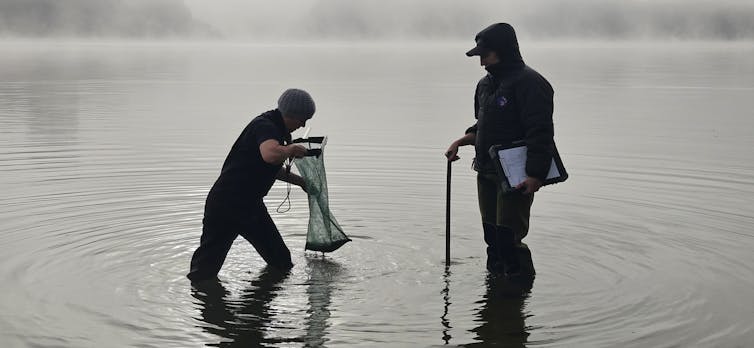
Field teams survey the rapidly expanding population of freshwater gold clams in the Waikato River.Michele Melchior, CC BY-ND
How the clams are changing the river
The gold clam isn’t just a filter-feeder; it’s an ecosystem engineer. Each clam can process up to a litre of water per hour, sequestering calcium for shells while releasing ammonia and bicarbonate.
Our data from 2024-2025, collected at multiple sites, show these shifts are most pronounced in deeper waters. Statistical tests confirm patterns absent in pre-invasion records.
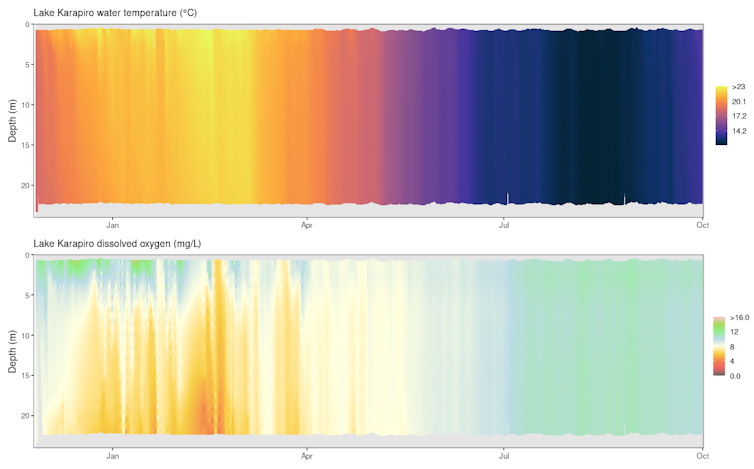
Longer residence times in the reservoir lake (up to seven days) exacerbate the issue. Faster flushing correlates with higher growth rates, as clams ramp up activity. But prolonged retention in warmer months can lead to hypoxia (low oxygen), with the potential to trigger mass die-offs that release toxins or mobilise sediment-bound arsenic.
Lake Karapiro water column temperature and dissolved oxygen levels (from November 2024 to October 2025) show oxygen depletion in deep water during warmer summer conditions, likely exacerbated by the gold clam.Author provided, CC BY-NC-ND
These changes threaten more than water treatment. Clams could biofoul dam intakes and reduce hydroelectric efficiency in a river that generates 13% of New Zealand’s power (25% at peak). Native species like kakahi (freshwater mussels) face competition and shifts in nutrient cycling could fuel algal blooms, clashing with restoration goals.
Climate risks and stressors in a warming world
Amid these ongoing changes, climate projections indicate that hot, dry events – such as prolonged heatwaves or droughts – are likely to become more frequent. Such conditions could reduce river flows and elevate water temperatures, lowering dissolved oxygen levels and creating low-oxygen zones.
If clam densities continue to rise exponentially, a mass die-off might occur. This would release pulses of ammonia and organic matter that further deplete dissolved oxygen. This, in turn, could promote arsenic mobilisation from sediments and harmful algal blooms in nutrient-enriched, stagnant waters.
This could necessitate supply restrictions for affected communities. Ecologically, it might kill fish and disrupt native biodiversity. Economically, it could interrupt industries reliant on the river.
From the Waikato to a nationwide threat
The invasion isn’t contained. The clam, which can produce up to 70,000 juveniles annually, thrives in warm, nutrient-rich waters. It is notoriously hard to eradicate once established.
In mid-November, the Taranaki Regional Council confirmed the gold clam in Lake Rotomanu. Just days later, warnings were issued to boaties on the Whanganui River, urging rigorous “check, clean, dry” protocols.
Without intervention, the clams could reach other systems, including the Clutha or Waitaki, and compound pressures on New Zealand’s already stressed freshwaters.
Our research highlights the need for integrated action. Monitoring should expand, incorporating environmental DNA for early detection and calcium isotope tracing to pinpoint clam impacts. Water providers could trial calcium dosing during peak growth periods.
But solutions must honour Te Tiriti o Waitangi principles. Collaboration with iwi and blending matauranga Maori (indigenous knowledge) with science, such as using tikanga indicators for water health, is essential. Biosecurity measures including gear decontamination campaigns are critical to slow spread.
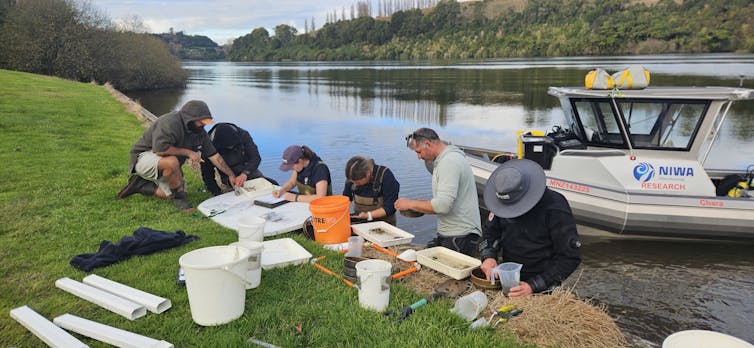
Field teams are counting invasive gold clams on the banks of the Waikato River.Michele Melchior, CC BY-ND
This invasion intersects with New Zealand’s evolving water policy framework, particularly the Local Water Done Well regime which replaced the repealed Three Waters reforms in late 2023.
But a hot or dry event could test the effectiveness of water policy, potentially straining inter-council coordination for shared resources such as the Waikato River and highlighting gaps in emergency response.
Globally, the gold clam has cost billions in damages. New Zealand can’t afford to wait. By acting now, we can protect Te Awa o Waikato and safeguard water security for generations.
Adam Hartland receives funding from the Ministry of Business, Innovation and Employment via grant LVLX2302.
This article is republished from The Conversation under a Creative Commons license.