But how much will the world change if America’s stance is different?
Some scholars of international relations argue that because Washington has been central to global governance for so long, Trump’s “America First” turn – suggesting isolationism on some issues and unilateral action on others – spells the end of the international order as we’ve known it.
The most pessimistic analysts caution that the era of “Pax Americana,” or the long period of relative world calm since World War II due to U.S. leadership, is coming to a close. They forecast a turbulent transition to a more chaotic world.
This view may well prove correct in the long run. But it is too early to say with confidence. As a scholar who studies U.S. foreign policy, I see some grounds for optimism. The world can become a more just, stable and secure place despite the diminishment of American leadership.
For the remaining three years of Trump’s presidency, all bets are off. Trump is famously difficult to predict. That world leaders genuinely believed in recent weeks that the United States could invade Greenland – and still might – should give pause to anyone who thinks they can foretell the remainder of Trump’s second term.
But the long-term trends are clear: The United States is losing its enthusiasm (and capacity) for global leadership. The rest of the world can assume that, after Trump, there will continue to be a decline in America’s participation in world affairs. His recent actions suggest America’s security guarantees to others will become more dubious, its markets will become less accessible to foreigners, and its support for international institutions will weaken.
Does this mean a cascade of disorder for smaller nations? Perhaps – but not necessarily.
Are US allies more vulnerable?
Certainly U.S. foreign policy and its wars and other actions abroad have sparked criticism over the past few decades. Still, the prospect of U.S. retrenchment understandably causes anxiety for those who have long sheltered under America’s security umbrella.
Once U.S. forces, spread throughout the globe, have decamped to the continental United States, the argument goes, there won’t be much stopping large countries such as Russia and China from steamrolling their vulnerable neighbors in Europe and East Asia.
This is an overly pessimistic assessment, in my view. It must be remembered that America’s alliance commitments and vast military deployments date from the early Cold War of the 1950s, an era that bears few similarities with the present day. Back then, U.S. forces were needed to deter the Soviet Union and China from attacking their neighbors, who were almost uniformly weak and impoverished following the Second World War.
Will the world become poorer and perhaps more dangerous if global economic integration falls by the wayside?
This is a reasonable concern given the standard view that free trade leads to economic growth and, in turn, that economic growth can help foster world peace.
But again, it is wrong to assume that the worst will happen. Instead of accepting that globalization is irreversibly in retreat, there is every chance that governments will relearn the benefits of economic integration and defend an open world economy, even absent U.S. leadership. After all, Trump’s trade wars have visibly harmed U.S. firms and consumers, as well as caused friction with America’s allies. Future leaders in Washington and around the world will presumably learn from such fallout.
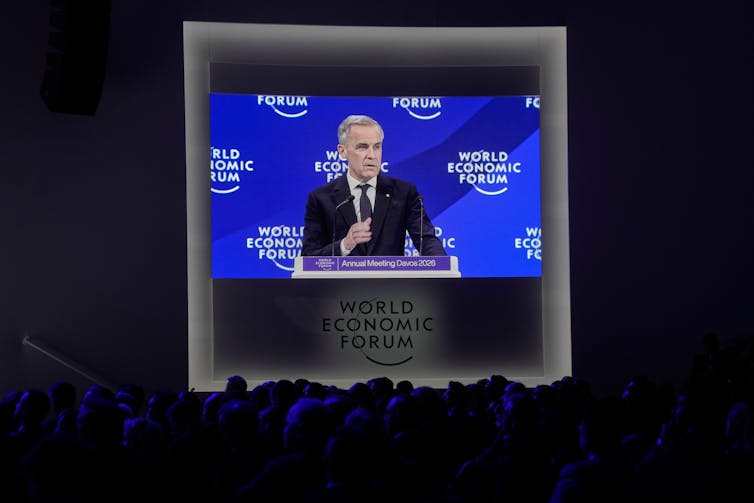
Finally, there is no reason to conclude that global governance must collapse in the absence of strong U.S. leadership. As Canadian Prime Minister Mark Carney proposed at the recent Davos conference in Switzerland, so-called middle powers, such as Australia, Brazil and Canada itself, have the capacity to rescue the world’s most vital international organizations for the benefit of future generations, and to create new institutions as necessary.
Canadian Prime Minister Mark Carney gave a speech at Davos that suggested possible outlines for a post-American world.AP Photo/Markus Schreiber
Nations such as Canada, Japan, Australia and the members of the European Union obviously lack the overwhelming military power and economic clout of the United States. But they could choose instead to implement a more collective approach to global leadership.
No safe bets
There are obviously no guarantees that the post-Pax Americana era will be an unbridled success. There will be war and suffering in the future, just as there has been war and suffering under U.S. leadership. The idea of Pax Americana has always rung hollow to some people, including citizens of countries that have been attacked by the United States itself.
The question is whether the international system will become any more violent and unstable in the absence of U.S. leadership and military dominance than it has been during America’s long period of global dominance. It well might, but the international community shouldn’t resign itself to fatalism.
The United States has lost influence. The silver lining is that more countries – including America’s friends and allies – might rediscover their own capacity to shape world affairs.
The post-American era is therefore up for grabs.
Peter Harris is a Non-Resident Fellow with Defense Priorities.
This article is republished from The Conversation under a Creative Commons license.