Deeper ocean ecosystems are unique – and uniquely vulnerable without better protection
A new study challenges a common assumption that deeper marine ecosystems act as refuges which could reseed damaged shallower reef systems.
James J Bell, Professor of Marine Biology, Te Herenga Waka — Victoria University of Wellington, Manon Broadribb, Postdoctoral Researcher in Marine Science, Te Herenga Waka — Victoria University of Wellington
27 February 2026
New Zealand’s earlier efforts to safeguard marine or coastal environments, particularly as marine reserves and marine protected areas, typically focused on shallow ecosystems, largely because that is where most data exists.
But following the passing of the Hauraki Gulf Marine Protection Act last year, it was good to see many deep rocky reefs among the 12 new high protection areas (HPAs).
These areas prohibit recreational and commercial fishing while allowing certain customary practices in ways that reduce or eliminate extractive activities, helping ecosystems recover and rebuild.
This is important because deeper reefs often host protected species and this recognises the need to protect these habitats.
As our new research shows, even just 50 metres of depth can separate entirely different marine communities.
In this study at the Poor Knights Islands Marine Reserve off northeastern Aotearoa New Zealand, we examined sponge assemblages – a major component of temperate rocky reefs – from 5 to 65 metres in depth.
Sponges play an important role in filtering water, recycling nutrients and creating habitat for other organisms. They are also sensitive to environmental change, including marine heatwaves.
Reefs do not simply continue unchanged with greater depth. In fact, deeper communities in the “mesophotic” zone, typically found at 30–150 metres of depth, can host very distinct species that never occur in the shallows.
If conservation efforts don’t recognise this, we may be leaving a significant portion of marine biodiversity unprotected.
Different communities at depth
Our results were striking. Sponge assemblages were strongly structured by depth.
Most species were depth specialists, found either in shallow reefs less than 30 metres deep or in deeper mesophotic zones, but not both.
Across all sites we surveyed, we identified 64 sponge species or operational taxonomic units. Only 18 occurred across multiple depths spanning both shallow and mesophotic zones. In other words, less than a third of species had distributions broad enough to potentially link the two zones.
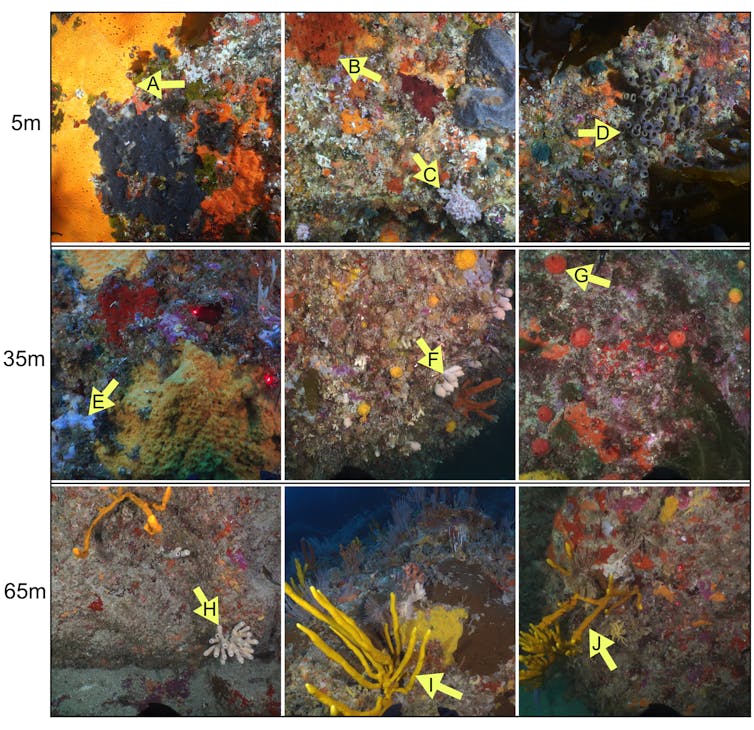
Differences between depths were driven mainly by species replacement, not by shallow communities simply becoming poorer versions of deeper ones. This means mesophotic reefs are not just extensions of shallow reefs. They are ecologically distinct systems.
Shallow depths tend to support sponge assemblages dominated by encrusting and low-lying species such as those shown in the images from A to D, while upper mesophotic depths are dominated by species with mounding, tubular and golf ball forms (E to G). Meanwhile, middle mesophotic depths host assemblages made up of many branching sponges (H-J).James Bell, CC BY-NC-ND
Are deep reefs climate refuges?
For years, scientists have debated whether deeper reefs might serve as refuges during disturbances such as marine heatwaves, which can disproportionately affect shallower ecosystems.
The idea, known as the deep reef refugia hypothesis, suggests deeper populations could survive warming events and later reseed damaged shallow reefs.
There is some evidence this can occur for certain species. In our study, a small subset of depth generalist sponges occurred consistently across both zones. These species may have the potential to benefit if deeper habitats avoid disturbances that impact shallower waters.
But our findings suggest this refuge effect may apply only to a minority of species. Most sponges had narrow depth ranges. If shallow populations decline, deeper reefs will not automatically act as a backup for entire assemblages.
This challenges the common assumption that deeper reefs can safeguard shallow biodiversity at an ecosystem level.
Why this matters
Marine protected areas in shallow, accessible habitats are easier to survey, monitor and manage. But biodiversity does not stop at 30 metres.
If deeper reefs host distinct communities, then protecting only the shallows leaves much of that biodiversity exposed to fishing pressure and other anthropogenic impacts.
Our assessment of the current network of 44 marine reserves in New Zealand shows the majority contain areas of rocky reef, but only half have reefs below 50 metres.
Importantly, these include New Zealand’s larger offshore reserves (the Kermadec Islands, Auckland Islands, Bounty Islands, Campbell Island and Antipodes Island), which means the total protected area deeper than 50 metres comes to an impressive 16,294 square kilometres (about the size of the Auckland region).
However, these offshore marine reserves extend far deeper than the mesophotic zone and only a fraction of this area is rocky reef. When discounting the larger offshore reserves, the total area covered by marine reserves deeper than 50 metres is only 394 square kilometres, less than 1% of New Zealand’s territorial seas.
Distribution of all New Zealand marine reserves. Yellow stars indicate marine reserves containing seabed at depths of 50 metres or greater (mesophotic zone), and orange circles indicate reserves shallower than 50 metres.Bathymetric data from GEBCO global gridded bathymetry dataset; marine reserve boundary data from Land Information New Zealand, CC BY-NC-ND
This has direct implications for marine spatial planning in Aotearoa New Zealand and globally.
Our research suggests ensuring the protection of both deep and shallow areas in the same geographical regions is essential if we want to safeguard the full spectrum of reef biodiversity. Protecting shallow reefs alone will not automatically protect deeper mesophotic species or vice versa.
Mesophotic reefs are often out of sight and out of mind. They lie beyond most recreational diving depths and are less studied than their shallow counterparts. Yet they can host rich sponge assemblages and other invertebrate communities that contribute significantly to ecosystem functioning.
They are also not immune to change. Ocean warming, shifting currents and sedimentation can all influence deeper habitats. While depth may buffer some disturbances, it does not guarantee protection.
Our findings add to a growing body of evidence that temperate mesophotic ecosystems should be managed as distinct ecological entities. They are not simply deeper versions of shallow reefs, nor are they universal refuges.
As climate change intensifies and marine heatwaves become more frequent, conservation planning must consider how biodiversity is structured across depth. This means designing protected areas that encompass entire reef profiles, from the surface to the limits of light penetration.
James J Bell receives funding from the Department of Conservation, the Greater Wellington Regional Council, Centerport, The George Mason Charitable Trust and The Royal Society of New Zealand Marsden Fund. He is also supported by a Royal Society of New Zealand Mana Tuarangi Distinguished Researcher Fellowship.
Manon Broadribb does not work for, consult, own shares in or receive funding from any company or organisation that would benefit from this article, and has disclosed no relevant affiliations beyond their academic appointment.
This article is republished from The Conversation under a Creative Commons license.
RUGBY Portia Woodman-Wickcliffe has retired from rugby for a second time, aged 34 More...
BUSINESS Rocket Lab's continuing to thunder to new heights, posting a record revenue of 300 million New Zealand dollars in the last three months of 2025 More...