Iran protests 2026: our surveys show Iranians agree more on regime change than what might come next
Surveys reveal the overwhelming support for an end to the Islamic Republic.
Ammar Maleki, Assistant Professor, Public Law and Governance, Tilburg University, Pooyan Tamimi Arab, Associate Professor of Secular and Religious Studies, Utrecht University
13 January 2026
Iranians have shown a willingness to pay a devastating price for political change, as protest has consistently been met by the Islamic Republic with violence and mass killing. The death toll since Iranians took to the streets on December 28 has reportedly passed 500, with more than 10,000 arrested. Incoming reports put the casualty count much higher.
A clear majority of Iranians do not want the theocracy that came to power with the 1979 revolution. They want a secular democracy. But what does public opinion tell us about what that should entail and how this change should be achieved?
Measuring public opinion in one of the world’s most repressive countries is not an easy matter. Conventional surveys conducted through (landline) phones or by face-to-face interviews tend to reflect an implausibly homogeneous Islamic and pro-regime society. By contrast, Gamaan — the Group for Analysing and Measuring Attitudes in Iran — conducts surveys anonymously through the internet.
Our research is based on representative samples of anything from tens of thousands to over 100,000 respondents. In 2020 a Gamaan survey revealed a diverse, secularising and dissident society, in which around 70% rejected the compulsory hijab. These numbers materialised in the streets in 2022, during the “woman life freedom” protests (find out more about sample characteristics, weighting information, and external benchmark tests at gamaan.org and this Wapor methodology webinar).
To improve randomisation, we collaborate with Psiphon VPN, which is widely used across Iran. By 2025, an estimated 90% of Iranian internet users relied on VPNs to access blocked platforms, including basic messaging apps such as Whatsapp.
This level of coverage enabled what we call VPN sampling, yielding large, socially diverse samples under conditions of safety and anonymity. Combined with scale, anonymity offers reliable insight into what Iranians really want. The latest survey on the 12-day war with Israel, taken in September 2025, secured more than 30,000 responses from inside the country.
Why protests, again? What is different?
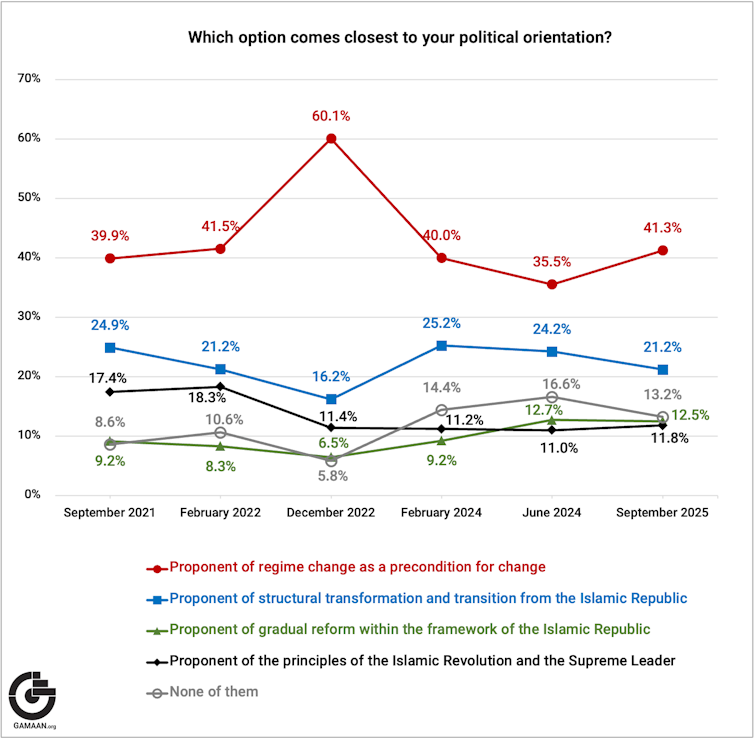
Our surveys consistently show that the majority shares a consensus on what it does not want. Across provinces, rural and urban areas, age groups and gender, roughly 70–80% say they would not vote for the Islamic Republic.
In all survey waves, support for regime change as a precondition for meaningful progress has been the most popular position. This support previously spiked during the “woman life freedom” protests. We believe we are currently witnessing another spike, given the increase observed after the 12-day war.
Results from GAMAAN’s surveys conducted between 2021 and 2025.CC BY-ND
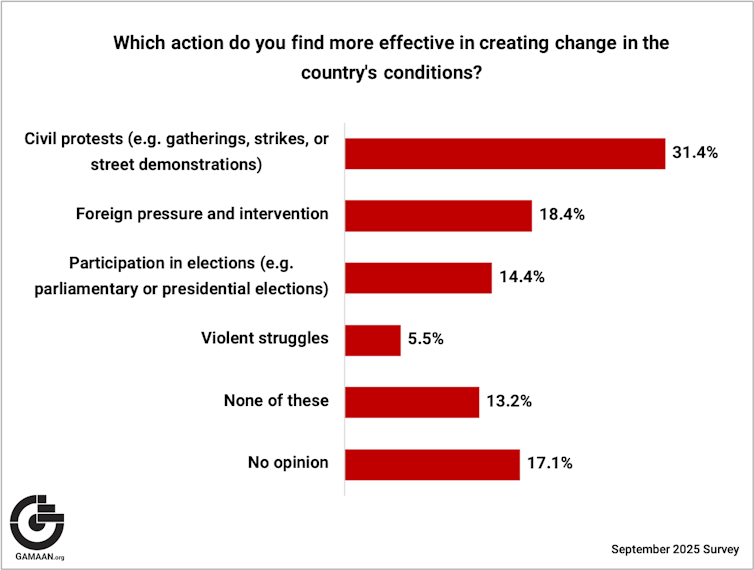
Iranians believe that protests, foreign pressure and intervention are more likely to bring about political change than elections and reforms. They were thus emboldened when, for the first time, a US president threatened intervention should protesters be killed. This came days after the abduction by the US military of the Venezuelan president, Nicolás Maduro, a key ally of the Islamic Republic.
Results from GAMAAN’s 2025 survey on the 12-Day War.CC BY-ND
The popularity of Reza Pahlavi, the former crown prince in exile who represents inherited monarchical nationalism, can be understood in light of this Iran-first mentality. Pahlavi’s social base remained stable in Gamaan’s surveys between 2022 and 2025. Roughly one-third are strong supporters and another third strongly oppose him. The remaining segment somewhat agrees or disagrees, or expresses no opinion.
The current surge in pro-Pahlavi slogans suggests that his popularity is attracting segments of the latter moderate or undecided population. But our surveys found that his popularity is unevenly distributed. It is lower in provinces with higher ethnic minority populations, such as the Kurds, Azeri Turks and Baluch.
Results from GAMAAN’s 2025 survey on the 12-day war.CC BY-ND
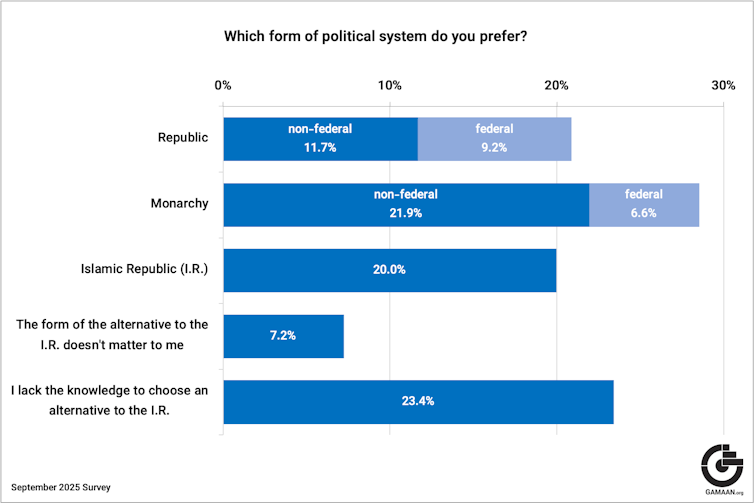
Although there is no consensus on the form or structure of an alternative political system, it is noteworthy that in 2025 there was, for the first time, a marked increase in support for monarchy. Given the significant size of those who do not voice a strong opinion on the alternative, any group that can successfully topple the Islamic Republic will have an advantage in convincing the majority to adopt its proposed model.
Results from GAMAAN’s 2025 survey on the 12-day war.CC BY-ND
Iranians overwhelmingly support a “democratic political system” – with 89% in favour. Support for political liberalism, however, is weaker. In 2024, 43% agreed with having “a strong leader who does not have to bother with parliament and elections”. This view is significantly higher among those without higher education – among monarchists, it is 49%.
These facts should not be lamented or mocked but understood, if the threat of a lack of liberalism is to be mitigated. While nationalism may generate the force of a revolutionary storm capable of toppling the regime, long-term stability, after the fall of the Islamic Republic, will also require an acceptance of Iran’s cultural and ideological diversity as permanent features of a truly free nation.
Ammar Maleki is the founder and director of non-profit GAMAAN. He was selected as World Association for Public Opinion Research’s national representative for Iran for the 2025–2027 term.
Pooyan Tamimi Arab receives funding from the Dutch Research Council for the project Iran’s Secular Shift (2025-2030; VI.Vidi.231F.020). He is a board member of the non-profit research institute GAMAAN.
This article is republished from The Conversation under a Creative Commons license.