Are we the Martians? The intriguing idea that life on Earth began on the red planet
Mars may have been hospitable to life early in its history.
Seán Jordan, Associate Professor in Chemistry, Dublin City University
30 December 2025
How did life begin on Earth? While scientists have theories, they don’t yet fully understand the precise chemical steps that led to biology, or when the first primitive life forms appeared.
But what if Earth’s life did not originate here, instead arriving on meteorites from Mars? It’s not the most favoured theory for life’s origins, but it remains an intriguing hypothesis. Here, we’ll examine the evidence for and against.
Timing is a key factor. Mars formed around 4.6 billion years ago, while Earth is slightly younger at 4.54 billion years old. The surfaces of both planets were initially molten, before gradually cooling and hardening.
Life could, in theory, have arisen independently on both Earth and Mars shortly after formation. While the surface of Mars today is probably uninhabitable for life as we know it, early Mars probably had similar conditions to the early Earth.
Early Mars seems to have had a protective atmosphere and liquid water in the form of oceans, rivers, and lakes. It may also have been geothermally active, with plenty of hydrothermal vents and hot springs to provide the necessary conditions for the emergence of life.
However, about 4.51 billion years ago, a Mars-sized, rocky planet called Theia crashed into the proto-Earth. This impact caused both bodies to melt together and then separate into our Earth and its moon. If life had begun before this event, it certainly would not have survived it.
Mars, on the other hand, probably didn’t experience a global remelting event. The red planet had its fair share of impacts in the violent early solar system, but evidence suggests that none of these would have been large enough to completely destroy the planet – and some areas could have remained relatively stable.
So if life arose on Mars shortly after formation of the planet 4.6 billion years ago, it could have continued evolving without major interruptions for at least half a billion years. After this time, Mars’ magnetic field collapsed, marking the beginning of the end for Martian habitability. The protective atmosphere disappeared, leaving the planet’s surface exposed to freezing temperatures and ionising radiation from space.
Supercomputer simulation showing the collision between the Earth and a Mars-sized body that formed the Moon.
A question of timing
But what of Earth: how soon did life appear after the impact that formed the Moon? Tracing the tree of life back to its root leads to a microorganism called Luca – the last universal common ancestor. This is the microbial species from which all life today is descended. A recent study reconstructed Luca’s characteristics using genetics and the fossil record of early life on Earth. It inferred that Luca lived 4.2 billion years ago – earlier than some previous estimates.
Luca was not the earliest organism on Earth, but one of multiple species of microbe existing in tandem on our planet at this time. They were competing, cooperating, and surviving the elements, as well as fending off attacks from viruses.
If small but fairly complex ecosystems were present on Earth around 4.2 billion years ago, life must have originated earlier. But how much earlier? The new estimate for the age of Luca is 360 million years after the formation of the Earth and 290 million years after the Moon-forming impact. All we know is that in these 290 million years, chemistry somehow became biology. Was this enough time for life to originate on Earth and then diversify into the ecosystems present when Luca was alive?
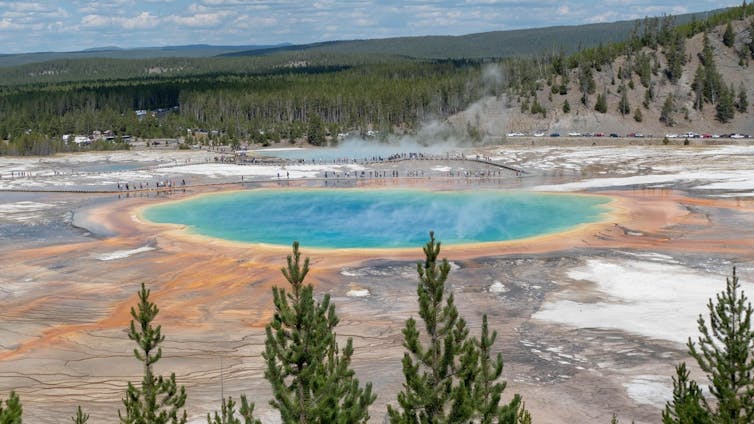
Luca’s habitat was either a shallow marine hydrothermal vent system or a geothermal hot spring, like this spectacular example in Yellowstone, US.NPS/Diane Renkin
A Martian origin for terrestrial life circumvents this question. According to the hypothesis, species of Martian microorganism could have travelled to Earth on meteorites just in time to take advantage of the clement conditions following the Moon’s formation.
The timing may be convenient for this idea. However, as someone who works in the field, my hunch would be that 290 million years is plenty of time for chemical reactions to produce the first living organisms on Earth, and for biology to subsequently diversify and become more complex.
Surviving the journey
Luca’s reconstructed genome suggests that it could live off molecular hydrogen or simple organic molecules as food sources. Along with other evidence, this suggests that Luca’s habitat was either a shallow marine hydrothermal vent system or a geothermal hot spring. Current thought in the origin of life field is that these kinds of environments on the early Earth had the necessary conditions for life to emerge from non-living chemistry.
Luca also contained biochemical machinery that could protect it from high temperatures and UV radiation – real dangers in these early Earth environments.
However, it’s far from certain that early life forms could have survived the journey from Mars to Earth. And there’s nothing in Luca’s genome to suggest that it was particularly well adapted to space flight.
In order to have made it to Earth, microorganisms would need to have survived the initial impact on Mars’ surface, a high speed ejection from the Martian atmosphere and travel through the vacuum of space while being bombarded by cosmic rays for at least the best part of a year.
They would then have needed to survive the high-temperature entry through Earth’s atmosphere and another impact onto the surface. This last event may or may not have deposited it in an environment to which it was even remotely adapted.
The chances of all of this seem pretty slim to me. However difficult the transition from chemistry to biology may appear, it seems far easier to me than the idea that this transition would occur on Mars, with life forms surviving the journey to Earth, and then adapting to a completely new planet. However, I could be wrong.
It’s useful to look at studies of whether microorganisms could survive the journey between planets. So far, it looks like only the hardiest microorganisms could survive the journey between Mars and Earth. These are species adapted to preventing damage from radiation and capable of surviving desiccation through the formation of spores.
But maybe, just maybe, if a population of microorganisms were trapped in the interior of a sufficiently large meteorite, they could be protected from most of the harsh conditions of space. Some computer simulations even support this idea. Further simulations and laboratory experiments to test this are ongoing.
This raises another question – if life made it from Mars to Earth within the first 500 million years of our Solar System’s existence, why hasn’t it spread from Earth to the rest of the Solar System in the following four billion years? Maybe we’re not the Martians after all.
Seán Jordan does not work for, consult, own shares in or receive funding from any company or organisation that would benefit from this article, and has disclosed no relevant affiliations beyond their academic appointment.
This article is republished from The Conversation under a Creative Commons license.
RUGBY Nick Kyrgios has blitzed Aryna Sabalenka in straight sets 6-3, 6-3 across what has been coined their battle-of-the-sexes tennis match in Dubai More...
BUSINESS The EU's new deforestation regulation could be favourable to New Zealand - when it eventually kicks in More...